


 cases
cases
So far we have not discussed whether all
matrices are
like the three examples--and they aren't! On the other hand, not
many different kinds of things can happen. Here are the
typical cases:
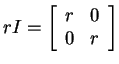 . Here
the only eigenvalue is
. Here
the only eigenvalue is
 and every nonzero vector is
an eigenvector.
and every nonzero vector is
an eigenvector.
 with
with  . Here
the eigenvectors lie on the
. Here
the eigenvectors lie on the  - and
- and  -axes and the
eigenvalues are just the diagonal entries.
-axes and the
eigenvalues are just the diagonal entries.
![[*]](/lib/latex2html-icons/crossref.gif) .
.
. Here there are two eigenspaces (lines of eigenvectors).
 rotation. In this case there are no
real eigenvectors either. However, if we are willing to use
complex numbers then these matrices are like the previous case;
they do have complex eigenvalues with corresponding eigenvectors.
rotation. In this case there are no
real eigenvectors either. However, if we are willing to use
complex numbers then these matrices are like the previous case;
they do have complex eigenvalues with corresponding eigenvectors.
 ; (ii) nonzero
matrices that are ``nilpotent'', which means some power is the
zero matrix, for example
; (ii) nonzero
matrices that are ``nilpotent'', which means some power is the
zero matrix, for example
 ; and (iii)
nilpotent matrices added to scalar matrices, as in
; and (iii)
nilpotent matrices added to scalar matrices, as in
 . These are strange in many ways. For
example, they have only one line of eigenvectors.
. These are strange in many ways. For
example, they have only one line of eigenvectors.
Non-scalar
matrices with only one eigenvalue are
called ``defective''.
You can begin to see how any
matrix must be like one
of these examples:
 .
.
 ), then the
matrix is either scalar or else is case .
), then the
matrix is either scalar or else is case .
.
All this is assuming that the matrix has real entries, but these cases are pretty much the same even for matrices with complex entries.
It turns out that even
 matrices split into pieces that
fit these cases.
matrices split into pieces that
fit these cases.
Problem U-10. Classify the eight examples in the handout with pictures of a house according to this scheme. (The first example is the identity matrix.)
Problem
U-11. Show that a
matrix is diagonalizable if and
only if it is not defective. [This problem really should go after
the next section. Also, ``diagonalizable'' here means possibly
using complex numbers.]