


Notice that the characteristic polynomial is easy to find if the
matrix  is diagonal or even triangular:
Observation 1. The eigenvalues of a triangular matrix are just the diagonal entries.
Why? For the case of an upper-triangular
 matrix,
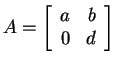 , notice that
 , so the roots are
  and
and  . Larger
matrices and lower-triangular matrices work the same.
. Larger
matrices and lower-triangular matrices work the same.
Another easy fact:
Observation 2. and  have the same characteristic
polynomial.
have the same characteristic
polynomial.
The reason is that a matrix and its transpose have
the same determinant, so
 , or
equivalently,
, or
equivalently,
 , or
equivalently,
, or
equivalently,
 .
.
Problem
U-8. A stochastic matrix is a square matrix such
as
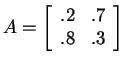 in which the entries are
  and
each column has sum 1. Stochastic matrices have many applications,
for example to shifts in populations over time. Let's stick to the
case for convenience, but larger cases work the
same.
and
each column has sum 1. Stochastic matrices have many applications,
for example to shifts in populations over time. Let's stick to the
case for convenience, but larger cases work the
same.
(a) Show that a
matrix has row sums all equal to
1 if and only if
 is an eigenvector for the
eigenvalue 1.
is an eigenvector for the
eigenvalue 1.
(b) Use Observation 2 to show that a stochastic
matrix has the eigenvalue 1. This is the same thing as having
a nonzero vector
v with
 v
v v, or in other words,
a nonzero ``fixed vector''.
v, or in other words,
a nonzero ``fixed vector''.
(c) Find a nonzero fixed vector for .
Problem
U-9. Explain: If has the eigenvalue 0, then the eigenvectors
for the eigenvalue 0 are all in the kernel of , and is singular.