


For the
 case, let's see what happens if we
``precompute'' the characteristic polynomial using letters, by
writing
case, let's see what happens if we
``precompute'' the characteristic polynomial using letters, by
writing
 :
:
 , so
, so
 .
.
Notice that the constant term is  . The coefficient of
 is
is  . The trace of a matrix means the sum
of the diagonal entries, so the coefficient of is
minus the trace.
. The trace of a matrix means the sum
of the diagonal entries, so the coefficient of is
minus the trace.
Now you can see this fact:
Observation. If  is
, then
is
, then
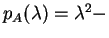 trace
trace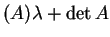 .
.
Now it becomes easy to write down the characteristic polynomials in the examples from the early sections of this handout:
For
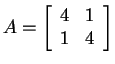 we get
trace
we get
trace .
.
For
 we get
trace.
we get
trace.
For
 we get
trace.
we get
trace.
This explains why all three examples had the same eigenvalues: All three had the same characteristic polynomial.
Problem
U-7. Invent two more
matrices with
characteristic polynomial
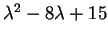 .
.