


For a square matrix  , to diagonalize means to find
a square matrix
, to diagonalize means to find
a square matrix  and diagonal matrix
  with
with
 .
.
In this case we say that diagonalizes . Notice that
has to be nonsingular or it won't have an inverse.
Some matrices are ``diagonalizable'' and others are not.
 For
For
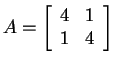 , it turns out that
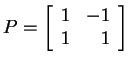 is a good matrix to diagonalize .
In fact,
for
is a good matrix to diagonalize .
In fact,
for
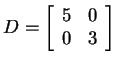 .
.
Notice that
 and
and
 are eigenvectors
of . In fact, is always made from eigenvectors:
are eigenvectors
of . In fact, is always made from eigenvectors:
Proposition. For
 matrices and ,
diagonalizes
matrices and ,
diagonalizes
 the columns of are
linearly independent eigenvectors of and the diagonal
entries of are the corresponding eigenvalues.
the columns of are
linearly independent eigenvectors of and the diagonal
entries of are the corresponding eigenvalues.
(The linear independence of columns is needed in order for
to be nonsingular. It wouldn't work, for instance, to have all
columns be the same. For the reasoning behind the Proposition,
see below.)
The Proposition tells how to diagonalize : Just find the
eigenvalues and corresponding eigenvectors. If there are enough
linearly independent eigenvectors, use them for the columns
of . The Example could be found that way.
Handy facts:
(1) Eigenvectors that belong to distinct eigenvalues are linearly
independent. Therefore, if is
and has  distinct eigenvalues, then is diagonalizable. (``Distinct''
means ``all different from one another''.)
distinct eigenvalues, then is diagonalizable. (``Distinct''
means ``all different from one another''.)
(2) A real symmetric matrix can always be diagonalized, even
if the eigenvalues are not all distinct (for example, if the
characteristic polynomial factors as
 ), we would say the eigenvalues are
  , not
all distinct.
, not
all distinct.
These two facts will be proved in class. Let's go back and prove the Proposition.
Proof of the Proposition. For ``
 '': To says that
diagonalizes means that
. If
we take this equation and multiply both sides by on the
left, we get
'': To says that
diagonalizes means that
. If
we take this equation and multiply both sides by on the
left, we get  . Now let's try to interpret this second
equation using eigenvalues and eigenvectors. We need two facts:
. Now let's try to interpret this second
equation using eigenvalues and eigenvectors. We need two facts:
 ,
the columns of the matrix on the right work independently; if
v
,
the columns of the matrix on the right work independently; if
v is the first column of then
v is
the first column of , and so on.
is the first column of then
v is
the first column of , and so on.
For example,
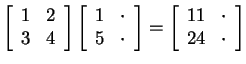 and it doesn't matter what the
other entries are.
and it doesn't matter what the
other entries are.
 , the effect is to multiply the
columns of the left-hand matrix by scalars (the diagonal entries
of ), so that if
v is the first column of then
, the effect is to multiply the
columns of the left-hand matrix by scalars (the diagonal entries
of ), so that if
v is the first column of then
 v is the first column of , and so on.
For example,
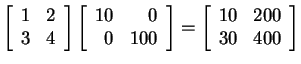 .
.
v v, so
v is an eigenvector of
and is the corresponding eigenvalue. (An
eigenvector can't be
0, but obviously
v
v, so
v is an eigenvector of
and is the corresponding eigenvalue. (An
eigenvector can't be
0, but obviously
v 0 since
it's a column of the invertible matrix .) Now look at the
second column
v
0 since
it's a column of the invertible matrix .) Now look at the
second column
v of ; by the same facts we
now get
v
of ; by the same facts we
now get
v v, so
v is
an eigenvector of with corresponding eigenvalue
v, so
v is
an eigenvector of with corresponding eigenvalue  .
The other columns of work similarly. The Proposition also
mentions that the columns of are linearly independent,
which is the same as saying that the column rank equals the number
of columns, but this is automatic since is invertible.
.
The other columns of work similarly. The Proposition also
mentions that the columns of are linearly independent,
which is the same as saying that the column rank equals the number
of columns, but this is automatic since is invertible.
We still need to prove ``
 '' in the Proposition. We start
by assuming we are given and such that the columns of
are eigenvectors of and are linearly independent.
The same two facts as before show that . Since the columns
of are linearly independent, has rank and is
invertible. Multiply both sides of on the left by
'' in the Proposition. We start
by assuming we are given and such that the columns of
are eigenvectors of and are linearly independent.
The same two facts as before show that . Since the columns
of are linearly independent, has rank and is
invertible. Multiply both sides of on the left by  ;
we get
, as required.
;
we get
, as required.
Problem
U-12. Diagonalize
 . (Use Problem U-
![[*]](/lib/latex2html-icons/crossref.gif) .)
.)
Problem
U-13. Explain how to interpret the equation
in
terms of a change of basis. What is the transformation? The old basis?
The matrix relative to the old basis? The new basis? The transition matrix?
The matrix relative to the new basis?