


Definition. For a square matrix  and scalar
  ,
the eigenspace of consists of all
v with
,
the eigenspace of consists of all
v with
 v
v v. We can call the eigenspace
 . In other
words,
consists of all eigenvectors for
and also the zero vector.
. In other
words,
consists of all eigenvectors for
and also the zero vector.
One advantage of talking about eigenspaces instead of eigenvectors is
that it's OK to talk about
even when is
not an eigenvalue of ; in that case,
 0
0 .
.
Another advantage is that it's easier to think about examples such as  ,
where
,
where  is the whole space, or
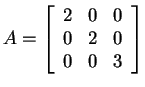 ,
where
,
where  is a plane.
Problem
U-14. Explain:
is the nullspace of
 ,
or equivalently, the kernel of
,
or equivalently, the kernel of
 . Therefore
is always a subspace.
. Therefore
is always a subspace.
Problem
U-15. In each case, make up an example of a
 matrix
so that
matrix
so that  is (a)
 0, (b) a line, (c) a plane,
(d) all of
0, (b) a line, (c) a plane,
(d) all of
 . (Suggestion: Use diagonal matrices.)