


Recall that the distance between two vectors is the length of
their difference. Therefore
 is the distance from
 x to
b. Moreover,
x to
b. Moreover,
 x
x . For a nonnegative
function, minimizing the square of the function is the same as
minimizing the function. Therefore
. For a nonnegative
function, minimizing the square of the function is the same as
minimizing the function. Therefore
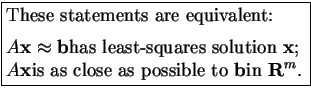
Moreover, the vectors of the form
x, for all possible
column vectors
x, form a subspace  of
R
of
R . Therefore
the problem is really one of finding the point in a subspace that is
closest to a given point; the error vector
. Therefore
the problem is really one of finding the point in a subspace that is
closest to a given point; the error vector  is the vector
from the given point to the point in the subspace. In Figure
is the vector
from the given point to the point in the subspace. In Figure ![[*]](/lib/latex2html-icons/crossref.gif) ,
the parallelogram represents part of the subspace .
The error vector ``err'' goes from
,
the parallelogram represents part of the subspace .
The error vector ``err'' goes from  to
x.
to
x.
To see why is a subspace, notice that is just the image
of the linear transformation given by
 x
x x.
Or, notice that
x can be expanded as
x
x.
Or, notice that
x can be expanded as
x , where
  means the
  -th column
of ; therefore is the column space of , i.e., the
subspace spanned by the columns of . In Figure , the
columns of are the sides of the parallelogram that touch the origin.
-th column
of ; therefore is the column space of , i.e., the
subspace spanned by the columns of . In Figure , the
columns of are the sides of the parallelogram that touch the origin.
You might think that the way to get from
b to the closest
point of is to go along a normal to --i.e., a line perpendicular
to --and that's exactly right, as indicated by the right angle in
Figure . First let's discuss the computational
method that produces the answer, and then then derivation of the method.