


One way to invent the method of normal equations is to use calculus.
The error is
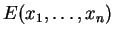 . Take the partial derivative with
respect to each
. Take the partial derivative with
respect to each  and set it equal to zero. You get
  simultaneous equations in
 , which turn out to
be the same as the normal equations.
, which turn out to
be the same as the normal equations.
Here is a better way, based on the geometrical interpretation discussed above. Recall that
(i) the set  of all vectors of the form
 x is a subspace, namely the column space of (the subspace
of
R
x is a subspace, namely the column space of (the subspace
of
R spanned by the columns of );
(ii) we are looking for the particular
x for which
x is closest to
b. To avoid confusion, call this vector
x ;
;
(iii) the error vector is
 x
x b.
b.
We need only two more facts:
(iv) The shortest distance from a vector b to a subspace is along a perpendicular. (See Problems for a verification.)
(v) In a matrix product  , the entries are dot products of rows
of with columns of
, the entries are dot products of rows
of with columns of  .
.
Now, by (iv),  is perpendicular to all vectors in .
By (i), the columns of are in , so is perpendicular
to each column of . Thus the dot product of with
every column of is zero. Write the dot products by putting
on its side and writing the matrix product
is perpendicular to all vectors in .
By (i), the columns of are in , so is perpendicular
to each column of . Thus the dot product of with
every column of is zero. Write the dot products by putting
on its side and writing the matrix product
 0.
0.
This says
 x b
x b , so
, so
 x
x b, the normal equations!