


For Problem DD-7:
One end of the semiminor axis is the point where
 ,
,
 ; here
x
; here
x![$ = R \left[\begin{array}{r}{\frac 1 2}\\ 0\end{array}\right] = [v _ 1 \vert v ...
...
= \left[\begin{array}{r}\frac {\sqrt 2}4\\ \frac {\sqrt 2}4\end{array}\right]$](img199.gif) . It can be checked that
this point is on the curve.
. It can be checked that
this point is on the curve.
Note: Sometimes ``semimajor axis'' means the length of the line segment from the origin and sometimes it means the line segment itself. We can tell by the context.
For Problem DD-8:
(a) As in the earlier explanation, when we start with
x x
x and substitute
x
and substitute
x r we get
r
r we get
r r,
or
r
r,
or
r r, where
![$ D = \left[\begin{array}{rr}\lambda _ 1&0\\ 0&\lambda _ 2\end{array}\right]$](img205.gif) .
Written out,
r r becomes
.
Written out,
r r becomes
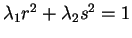 .
.
(b) If
 and
and
 are both positive, we get
an ellipse (or a circle, if they are equal). If one is positive and
the other negative, we get a hyperbola. If one is positive and the other
is 0, we get two parallel lines. In all other cases there are no points.
are both positive, we get
an ellipse (or a circle, if they are equal). If one is positive and
the other negative, we get a hyperbola. If one is positive and the other
is 0, we get two parallel lines. In all other cases there are no points.
Note: It is interesting to consider taking
to be
a fixed positive number and gradually changing
,
starting from
and then going negative. We'd see
an ellipse that expands along its major axis until it becomes two
parallel lines, which then bend back and becomes a hyperbola.
For Problem DD-9:
(a) Here
![$ A = \left[\begin{array}{rr}6&2\\ 2&9\end{array}\right]$](img209.gif) , as in Problem DD-
, as in Problem DD-![[*]](/lib/latex2html-icons/crossref.gif) .
In that problem we found
.
In that problem we found
 ,
,
 ,
so the transformed equation is
,
so the transformed equation is
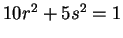 , giving
semiaxes
, giving
semiaxes
 and
and
 . Since the first
is smaller, it's the semiminor axis and the second is the semimajor axis.
. Since the first
is smaller, it's the semiminor axis and the second is the semimajor axis.
(b) In the earlier problem we saw
![$ R = \left[\begin{array}{rr}\frac 1{\sqrt 5}&
-\frac 2{\sqrt 5}\\ \frac 2{\sqrt 5}& \frac 1{\sqrt 5}\end{array}\right]$](img215.gif) (called
(called  there).
With
xr, for
there).
With
xr, for  , on the
  -axis we have
x
-axis we have
x![$ = R \left[\begin{array}{r}1\\ 0\end{array}\right] = \left[\begin{array}{r}\frac 1{\sqrt 5}\\ \frac 2{\sqrt 5}\end{array}\right]$](img218.gif) . The
slope of the axis is the
. The
slope of the axis is the  -value over the
  -value, so
is 2.
-value, so
is 2.