


For Problem DD-3:
Suppose
 are orthonormal. Suppose
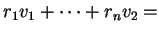 0. We must show
that
0. We must show
that
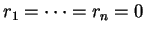 . Take the dot product of
both sides with
. Take the dot product of
both sides with  . Since the dot product is linear in
each of its two arguments (with the other held fixed), we get
. Since the dot product is linear in
each of its two arguments (with the other held fixed), we get
 . Since
 , this says
  .
Similarly, dotting both sides with each
.
Similarly, dotting both sides with each  in turn, we
get
in turn, we
get  for all
  , so the vectors are linearly
independent.
, so the vectors are linearly
independent.
For Problem DD-4:
In a matrix product  , the entries are the dot products of
the rows of
, the entries are the dot products of
the rows of  with the columns of
  . In
. In  ,
the rows of
,
the rows of  are the same as the columns of
  , transposed.
If the columns of are
, then, the
entries of are the numbers
, transposed.
If the columns of are
, then, the
entries of are the numbers
 .
Therefore
.
Therefore
 when
when
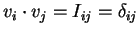 (the Kronecker delta symbol), which says the columns
of are orthonormal.
(the Kronecker delta symbol), which says the columns
of are orthonormal.
For Problem DD-5: It's an orthogonal matrix (orthonormal columns), so just take the transpose.
For Problem DD-6:
 implies
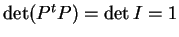 . Since
determinants are compatible with multiplication,
. Since
determinants are compatible with multiplication,
 . Since
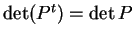 , we get
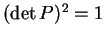 . The solutions of
  are
are  so
so
 .
.