


For Problem DD-1:
Assume (3). For (1): All matrices have real entries. Since  has real
eigenvalues (the diagonal entries), since
has real
eigenvalues (the diagonal entries), since  ,
and since similar matrices have the same eigenvalues,
,
and since similar matrices have the same eigenvalues,  has real
eigenvalues.
has real
eigenvalues.
For (2): Notice that it's OK if eigenvalues are repeated (i.e.,
have multiplicity greater than 1). For the diagonal matrix
and a given  , the eigenspace of is
the span of all
, the eigenspace of is
the span of all  with
with
 . Since
the standard basis vectors are perpendicular (orthogonal) to each
other, the eigenspaces are perpendicular. What is the
relationship between the eigenvectors of and those of
?
. Since
the standard basis vectors are perpendicular (orthogonal) to each
other, the eigenspaces are perpendicular. What is the
relationship between the eigenvectors of and those of
?
 says
says
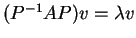 , or
, or
 . Therefore the eigenspace of for
is the eigenspace of for rotated by
. Therefore the eigenspace of for
is the eigenspace of for rotated by
 . Since
  is a rotation matrix,
is rigid and preserves angles, so the eigenspaces of
are also perpendicular to one another.
is a rotation matrix,
is rigid and preserves angles, so the eigenspaces of
are also perpendicular to one another.
Note. Maybe that was the hard way to show (2), since it's easy to prove (2) directly, as on p. DD 5.
Also notice that for an eigenspace
 ,
doesn't have to be an an eigenvalue, but if it's not, then
,
doesn't have to be an an eigenvalue, but if it's not, then
 0
0 .
.
For Problem DD-2:
 , so eigenvalues are
  and
and  . For
. For
 we have
![$ A - 10I = \left[\begin{array}{rr}-4&2\\ 2&-1\end{array}\right]$](img166.gif) and an
eigenvector is
and an
eigenvector is
![$ \left[\begin{array}{r}1\\ 2\end{array}\right]$](img14.gif) , which scales to
, which scales to
![$ \left[\begin{array}{r}\frac
1{\sqrt 5}\\ \frac 2{\sqrt 5}\end{array}\right]$](img167.gif) of length 1. For
of length 1. For
 we
have
we
have
![$ A - 5 I = \left[\begin{array}{rr}1&2\\ 2&4\end{array}\right]$](img169.gif) so an eigenvector is
so an eigenvector is
![$ \left[\begin{array}{r}2\\ -1\end{array}\right]$](img170.gif) , which scales to
, which scales to
![$ \left[\begin{array}{r}\frac 2{\sqrt 5}\\ -
\frac 1{\sqrt 5}\end{array}\right]$](img171.gif) . However, the matrix
. However, the matrix
![$ \left[\begin{array}{rr}\frac 1{\sqrt
5}& \frac 2{\sqrt 5}\\ \frac 2{\sqrt 5}& -\frac 1{\sqrt 5}\end{array}\right]$](img172.gif) has
determinant
has
determinant  , so let's negate the second column to get the
answer
, so let's negate the second column to get the
answer
![$ P = \left[\begin{array}{rr}\frac 1{\sqrt 5}& -\frac 2{\sqrt 5}\\ \frac
2{\sqrt 5}& \frac 1{\sqrt 5}\end{array}\right]$](img173.gif) . Now
. Now
 for
for
![$ D = \left[\begin{array}{rr}10&0\\ 0&5\end{array}\right]$](img174.gif) .
.