


For Problem DD-10:
(a) If
![$ A = \left[\begin{array}{cc}a&b\\ b&d\end{array}\right]$](img221.gif) , we can write
, we can write
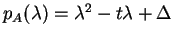 , where
  and
and
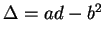 . The quadratic formula says the roots
are
. The quadratic formula says the roots
are
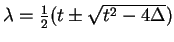 . Simplifying
the discriminant (the part inside the square root), we get
. Simplifying
the discriminant (the part inside the square root), we get
 .
.
(b) Since the discriminant is the sum of two squares and so is
 , the square root is real. Therefore the eigenvalues
are real and are
, the square root is real. Therefore the eigenvalues
are real and are
 .
.
(c) As suggested, the roots are equal when
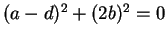 .
That happens when
.
That happens when  and
and  , which is when
![$ A = \left[\begin{array}{rr}a&0\\
0&a\end{array}\right]$](img232.gif) , a scalar matrix.
, a scalar matrix.
For Problem DD-11:
 u
u v
v u
u v and
v and
 u
u v
v u
u v
v u
u v u v (since
  is symmetric),
 uv
uv .
.