(Some of these problems depend on additional material from lectures.)
Problem
X-1. Describe (a) the free 1-unary algebra on  generators;
(b)  , where
  is the variety of 1-unary algebras with
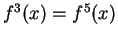 ;
;
(c) the free 2-unary algebra on  generator;
(d)  , where
 2
2 ,
using the table method. (Here
,
using the table method. (Here  is a semilattice--a set
with a single binary operation that is associative, commutative,
and idempotent. A semilattice can also be defined as a set with
a partial order such that any two elements have a least upper
bound. Thus one way to obtain a semilattice is to take a lattice
and ignore the meet operation, as has been done to make .)
is a semilattice--a set
with a single binary operation that is associative, commutative,
and idempotent. A semilattice can also be defined as a set with
a partial order such that any two elements have a least upper
bound. Thus one way to obtain a semilattice is to take a lattice
and ignore the meet operation, as has been done to make .)
Problem
X-2. Theorem. In a group  , every commutator
 is a product of squares.
Proof #1. Let
 products of
squares
products of
squares . Observe that is a normal subgroup. Moreover,
 satisfies
  and so is abelian. Then in
,
and so is abelian. Then in
,
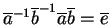 . This is the same as saying that in
,
. This is the same as saying that in
,
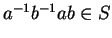 .
.
This proof was indirect. A more direct proof would be to
exhibit a law
 true in all groups, where each
  contains
some expression in
contains
some expression in  .
.
(a) Before attempting to give such a proof, explain why there must exist a direct proof of this form.
(b) Somehow or other, find the direct proof.
Problem
X-3. For Murskii's algebra  , suppose you want to
compute
, suppose you want to
compute  , using the table method. (a) Show what
generating rows you would use. (b) Compute new rows in some
reasonable order, labeling each row with the expression in the
generators that produced it, until you generate a row that is
already there. What law have you found? (c) If your law was in
one variable, continue further until you get a law involving two
variables. (d) Actually, has 11 elements. How
many multiplications of rows would be involved in computing the
whole free algebra and verifying that you are done?
, using the table method. (a) Show what
generating rows you would use. (b) Compute new rows in some
reasonable order, labeling each row with the expression in the
generators that produced it, until you generate a row that is
already there. What law have you found? (c) If your law was in
one variable, continue further until you get a law involving two
variables. (d) Actually, has 11 elements. How
many multiplications of rows would be involved in computing the
whole free algebra and verifying that you are done?
Problem
X-4. Two proofs of the existence of the free algebra  are described in §6 above. They sound very
different. Nevertheless, they are essentially the same. The
problem: Explain why, by analyzing how the two elements of the
first one are really present in the second.
are described in §6 above. They sound very
different. Nevertheless, they are essentially the same. The
problem: Explain why, by analyzing how the two elements of the
first one are really present in the second.
Problem
X-5. (a) Suppose that an algebra  has a given set
of generators
has a given set
of generators
 . Show that if has
the universal mapping property for maps into itself, then
is free in some variety . (Thus being free is in
effect an absolute property of an algebra, without having to
name a variety containing it.)
. Show that if has
the universal mapping property for maps into itself, then
is free in some variety . (Thus being free is in
effect an absolute property of an algebra, without having to
name a variety containing it.)
(b) An achievement of recent years was the solution of the
restricted Burnside problem: For any  and , there is a
largest finite group with generators that obeys
and , there is a
largest finite group with generators that obeys  . (There could also be infinite groups fitting this
description; it's just that there is a largest finite one.) Is
this largest finite group necessarily free? (Discuss.)
. (There could also be infinite groups fitting this
description; it's just that there is a largest finite one.) Is
this largest finite group necessarily free? (Discuss.)
Problem
X-6. Let be the variety of idempotent
semigroups: 1-binary algebras whose operation is associative
and obeys the law  .
.
By experimenting with expressions, make a conjecture as to
whether  is finite or infinite. Explain briefly how
you arrived at your answer.
is finite or infinite. Explain briefly how
you arrived at your answer.
Problem
X-7. The term algebra
 is described in
§3 above; in §6 it is used in the second proof of the
existence of free algebras in a variety.
is described in
§3 above; in §6 it is used in the second proof of the
existence of free algebras in a variety.
For the variety of 1-unary algebras obeying the law
and for  , explicitly describe
 and all
 Con
Con giving a
quotient in . (Here
giving a
quotient in . (Here
 .)
.)
Problem
X-8. Consider the ``constructions''
H SP on classes
of algebras.
SP on classes
of algebras.
(a) Say which containment relations between pairs of
constructions must hold, e.g.,
SH HS
HS . (All the valid relations have easy proofs, but it is not
required to write them down. Interpret
HSP up to
isomorphism.)
. (All the valid relations have easy proofs, but it is not
required to write them down. Interpret
HSP up to
isomorphism.)
(b) For one such potential relation that does not hold, find a counterexample, with brief proof.
Problem
X-9. Let
 . Refer to
Figure
. Refer to
Figure ![[*]](/lib/latex2html-icons/crossref.gif) . (a) Find a normal subgroup
. (a) Find a normal subgroup  of
such that
of
such that
 Z
Z Z
Z . (b) Find a normal
subgroup such that
. (b) Find a normal
subgroup such that
 . Find a normal subgroup
such that
. Find a normal subgroup
such that
 . Find the commutator subgroup
 of .
(Determine the order of each subgroup. Recall the Correspondence
Theorem, which says that the subgroups of that contain
form the same diagram as the subgroups of
of .
(Determine the order of each subgroup. Recall the Correspondence
Theorem, which says that the subgroups of that contain
form the same diagram as the subgroups of  ; the same
is true if just normal subgroups are considered. From the
previous problem you know that for abelian 2-groups (groups whose
order is a power of 2), the group can be identified from the
subgroup diagram. Recall that is contained in every
for which is abelian.)
; the same
is true if just normal subgroups are considered. From the
previous problem you know that for abelian 2-groups (groups whose
order is a power of 2), the group can be identified from the
subgroup diagram. Recall that is contained in every
for which is abelian.)
Problem
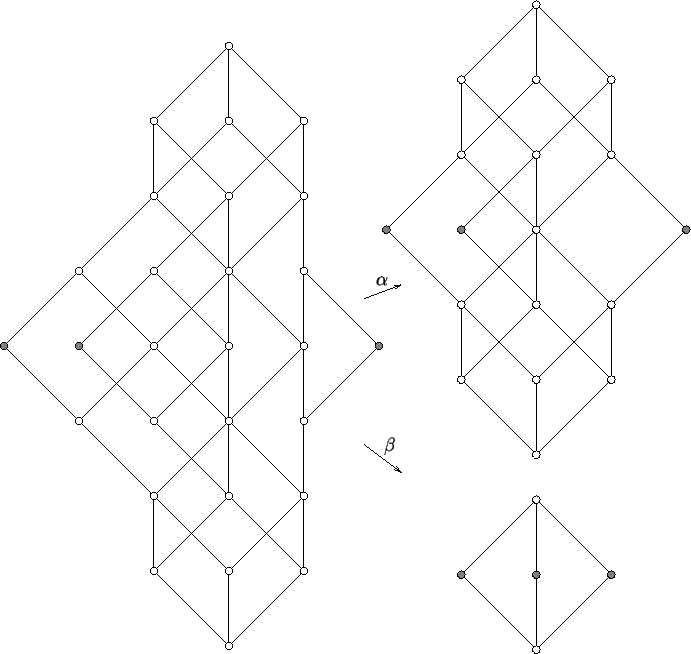
X-10. Figure shows homomorphisms of
FML onto
FDL and
onto
FDL and  , determined by mapping generators to
generators.
, determined by mapping generators to
generators.
On a copy of Figure , indicate
ker and
ker
and
ker . (You will need to decide which elements go to
which, but you need not write this information down.
A congruence relation on a finite lattice is best diagrammed
simply by darkening the coverings that are ``collapsed'', i.e.,
coverings between elements in the same block. Use different
coloring or markings for the two congruence relations involved.)
. (You will need to decide which elements go to
which, but you need not write this information down.
A congruence relation on a finite lattice is best diagrammed
simply by darkening the coverings that are ``collapsed'', i.e.,
coverings between elements in the same block. Use different
coloring or markings for the two congruence relations involved.)
Note. If there are surjections
 and
and
 whose
kernels have intersection 0, then
whose
kernels have intersection 0, then  is embeddable in
 , as we'll discuss in class. Since this is the case in
Figure , you have shown the interesting fact that
FML is embeddable in the direct product of
FDL
and a single copy of .
, as we'll discuss in class. Since this is the case in
Figure , you have shown the interesting fact that
FML is embeddable in the direct product of
FDL
and a single copy of .
Problem
X-11. For the free algebra from the table shown in Figure :
(a) Whenever we subtract two rows we get a relation between generators, which is then a law, usually nontrivial. What relation between generators, and so what law, comes from the computation R8-R9 = 0 2 1 1 0 2 2 1 0 = R5, where R8 means row 8, etc.?
(b) Suppose we want to use the universal mapping property to map
to with
 ,
,
 . Which column
of the table gives the projection that achieves this, and what
is the homomorphism on ?
. Which column
of the table gives the projection that achieves this, and what
is the homomorphism on ?