


7.1 Principles For
 Con
Con :
:
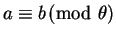
(1) If
 , then
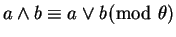 .
.
(2) If
 and
,
then
and
,
then
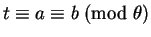 .
.
(3) If
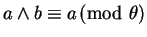 , then
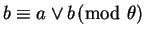 , and dually.
(4) If
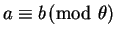 and
and
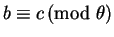 , then
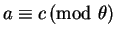 .
.
7.2 Theorems
(A) A nonempty relation  on a lattice is a congruence relation
if and only if satisfies (1) through (4).
on a lattice is a congruence relation
if and only if satisfies (1) through (4).
(B) For elements
 of a lattice
  ,
con
,
con , the smallest congruence relation on that identifies
 and
and  , can be constructed by applying (1)
(unless
, can be constructed by applying (1)
(unless
 already), then (2) and (3) repeatedly,
and then (4) repeatedly. This is the principal congruence relation
con
already), then (2) and (3) repeatedly,
and then (4) repeatedly. This is the principal congruence relation
con (lower-case c).
For examples to try, see Figure ![[*]](/lib/latex2html-icons/crossref.gif) . Congruence relations can be
indicated by darkening each covering between two elements in the same block.
. Congruence relations can be
indicated by darkening each covering between two elements in the same block.
![\begin{picture}(432,227)
\put(0,0){\includegraphics{\epsfile }}
\put(56,207){\ma...
...14){\makebox(0,7)[l]{$b_0$}}
\put(324,216){\makebox(0,7)[l]{(iv)}}
\end{picture}](img92.gif)