


Problem V-1. Verify that any congruence relation on a group is simply the coset decomposition determined by some normal subgroup.
Problem
V-2. For general algebras, prove (a) the first isomorphism theorem
(Theorem ![[*]](/lib/latex2html-icons/crossref.gif) ); (b) the correspondence theorem (Theorem
).
); (b) the correspondence theorem (Theorem
).
Problem
V-3. (a) Any function
 on sets induces an equivalence
relation on its domain
on sets induces an equivalence
relation on its domain  , where
  means
means
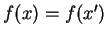 .
Show that for groups
.
Show that for groups  and
and  , if
, if
 is a homomorphism
then any single block of the equivalence relation it induces
determines all the blocks. (This is why the ``kernel'' of
is a homomorphism
then any single block of the equivalence relation it induces
determines all the blocks. (This is why the ``kernel'' of  is
defined to be a single block, the one containing
is
defined to be a single block, the one containing  .)
.)
(b) Give an example of two algebras and two homomorphisms
 between them such that and
  give
different equivalence relations that do have at least one block
in common. (This is why the ``kernel'' of is defined to
be the whole equivalence relation rather than a single block, for
algebras in general.)
give
different equivalence relations that do have at least one block
in common. (This is why the ``kernel'' of is defined to
be the whole equivalence relation rather than a single block, for
algebras in general.)
Problem
V-4. Explain how the congruence lattice of  is a sublattice
of the partition lattice of
is a sublattice
of the partition lattice of  as a set.
Problem
V-5. State and prove a version of Theorem that refers to two
surjective homomorphisms
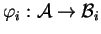 (
( ),
rather than to two congruence relations on .
),
rather than to two congruence relations on .
Problem
V-6. If
 is a surjective homomorphism, show that
there is a lattice embedding of
Con
is a surjective homomorphism, show that
there is a lattice embedding of
Con into
Con
into
Con ,
with the image being an interval.
,
with the image being an interval.
Problem
V-7. Invent a correspondence theorem (like Theorem
) for a surjective homomorphism
that relates subalgebras of  to certain
subalgebras of . Somehow describe which ones. (No
proof is required.)
to certain
subalgebras of . Somehow describe which ones. (No
proof is required.)
Problem
V-8. Show that the subdirect embedding theorem
() holds for the intersection of a possibly infinite
family of congruence relations.
Problem
V-9. For the case
 Z, the ring of integers, give
(a) an example of the subdirect embedding theorem in which the
two congruence relations come from prime ideals, and (b) an
example where neither comes from a prime ideal. In each case,
say what the embedding does to each element.
Z, the ring of integers, give
(a) an example of the subdirect embedding theorem in which the
two congruence relations come from prime ideals, and (b) an
example where neither comes from a prime ideal. In each case,
say what the embedding does to each element.
Problem
V-10. Prove that the congruence lattice of a chain of length  (as an algebra with lattice operations) is the Boolean lattice
2
(as an algebra with lattice operations) is the Boolean lattice
2 .
(The length of a chain is the number of jumps, so a chain of length
has
.
(The length of a chain is the number of jumps, so a chain of length
has  elements.)
Problem
V-11. Let  be a distributive lattice and consider any
  .
Define maps
.
Define maps
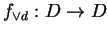 and
and
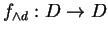 by
by
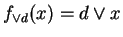 and
and
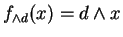 .
(a) Show that
.
(a) Show that
 and
and
 are homomorphisms.
(b) Show that the intersection of their kernels is 0 (i.e., equality).
(c) Use Theorems and to show that
are homomorphisms.
(b) Show that the intersection of their kernels is 0 (i.e., equality).
(c) Use Theorems and to show that
![$ {\cal D} \hookrightarrow ( d ] \times [ d )$](img115.gif) .
.
Problem
V-12. Compute all the principal congruence relations in Figure .
Indicate blocks by darkening coverings between two elements in the same
block. You may omit examples already done in lecture.