


For Problem Q-4:
(a) For
 , let's follow the suggestion and show that
 and
and  have the same divisors as
  and : If
 and
and  then
then  and
and  , i.e.,
  .
Therefore any divisor of and is also a divisor of
and .
.
Therefore any divisor of and is also a divisor of
and .
If and then and  , i.e., .
Therefore any divisor of and is a divisor of and
.
, i.e., .
Therefore any divisor of and is a divisor of and
.
Here we have use the pretty obvious idea that if  divides
then divides any integer multiple of and also
the idea that if divides two integers then it also divides
their sum and difference. Since `` divides '' means
``
divides
then divides any integer multiple of and also
the idea that if divides two integers then it also divides
their sum and difference. Since `` divides '' means
`` for some integer
  '', these rules are not hard
to prove officially.
'', these rules are not hard
to prove officially.
(b)
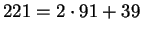 ;
;
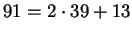 ;
;
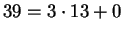 , so the gcd is
  .
.
(There was some secret algebra in inventing this problem:
 and
and
 . Both of these involve 13.)
For Problem Q-5:
Some informal reasoning that could be made official:
Run the Euclidean algorithm backwards. The integers
involved should build up as slowly as possible when the final
result, the gcd, is 1 and  is 1 in every step--except the last
(or the first going backwards), where
is 1 in every step--except the last
(or the first going backwards), where  won't work since the list of
numbers used has to increase. So going backwards, we have
won't work since the list of
numbers used has to increase. So going backwards, we have
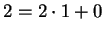

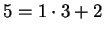
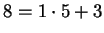

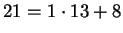
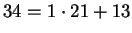
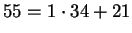 .
.
Note (not part this course). The sequence
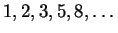 , in which each number from the third on is the sum of the
preceding two, consists of the Fibonacci numbers (fib-o-na-chi).
Actually it's better to start with
, in which each number from the third on is the sum of the
preceding two, consists of the Fibonacci numbers (fib-o-na-chi).
Actually it's better to start with  , getting
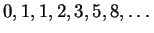 , even though that doesn't quite fit the
Euclidean algorithm application.
, even though that doesn't quite fit the
Euclidean algorithm application.
Fibonnaci numbers have a close connection to the golden mean
(golden ratio) of the ancient Greeks, the number that is the
positive solution of the equation
 , specifically
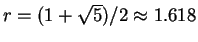 . In fact, the
  -th
Fibonacci number is the integer closest to
-th
Fibonacci number is the integer closest to
 if we
agree that 0 is the 0-th Fibonacci number. For example,
if we
agree that 0 is the 0-th Fibonacci number. For example,
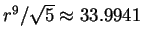 and
and
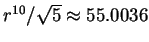 . Fibonacci numbers and the golden mean turn up in
unexpected places.
. Fibonacci numbers and the golden mean turn up in
unexpected places.
For Problem Q-6:
![$ \left[\begin{array}{ccc}91&1&0\\ 221&0&1\end{array}\right] \rightsquigarrow \...
...] \rightsquigarrow \left[\begin{array}{ccc}13&5&-2\\ 0&-17&7\end{array}\right]$](img194.gif) .
.
As a check notice that the right
 determinant is
still 1. Now we can see that
determinant is
still 1. Now we can see that  has to be
 , so
, so
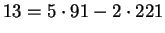 .
This checks.
.
This checks.
For Problem Q-7:
As suggested,
![$ \left[\begin{array}{ccc}101&1&0\\ 97&0&1\end{array}\right] \rightsquigarrow
...
... \left[\begin{array}{ccc}1&4&-1\\ 1&-24&25\end{array}\right] \rightsquigarrow $](img198.gif)
![$ \left[\begin{array}{ccc}0&97&101\\ 1&-24&25\end{array}\right]$](img199.gif) . Then
. Then
 , so
, so
 (which is true). Then in
 ,
,
 and the multiplicative inverse of
  is
is  .
.
The moral is that finding inverses in fields
 is fast and easy on a computer, even if
  is a large prime.
(For a computer, large can mean very large-even 200 digits!)
is a large prime.
(For a computer, large can mean very large-even 200 digits!)