


For Problem R-1:
A
 rotation, as a transformation on
 ,
has no eigenvectors. (Later we'll see that it does have eigenvectors
if complex numbers are allowed.)
,
has no eigenvectors. (Later we'll see that it does have eigenvectors
if complex numbers are allowed.)
A reflection in
 has two eigenspaces (line of
eigenvectors), one along the mirror line and one perpendicular
to the mirror line.
has two eigenspaces (line of
eigenvectors), one along the mirror line and one perpendicular
to the mirror line.
A shear has just one eigenspace, and it doesn't help to allow complex numbers.
For Problem R-2:
(a)
![$ P(D) = \left[\begin{array}{cc}p(1)&0\\ 0&p(2)\end{array}\right]$](img210.gif) , so we want
, so we want  and
and  .
Therefore we should use
.
Therefore we should use
 .
.
(b) For the same reason, let
 .
.
For Problem R-3:
To review: Writing  for an elementary matrix, when
we do successive elementary row operations starting from
for an elementary matrix, when
we do successive elementary row operations starting from  we are making
 ,
,
 , etc.
So if
, etc.
So if  is the end result after
  elementary row operations,
then
elementary row operations,
then  , where
 .
We know
.
We know  is invertible since can be undone by the
inverses of the elementary row operations:
is invertible since can be undone by the
inverses of the elementary row operations:
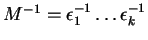 .
.
(a) If is row-reduced to then  as just
explained. The isomorphism is simply
as just
explained. The isomorphism is simply  , since is invertible (so is an isomorphism) and takes each
column of to the corresponding column of .
, since is invertible (so is an isomorphism) and takes each
column of to the corresponding column of .
One of you suggested that this point of view is another good way to see why linear relations among columns are preserved by row reduction even though the column space is changed: The column space is changed isomorphically!
(b) Since the isomorphism in (a) takes columns of to
corresponding columns of , a selection of columns that
makes a basis for the column space of corresponds to the
same thing for .