


For Problem Q-2:
The question is whether each example describes a partition. Reasons weren't required for positive answers, but I'll include them.
(a) No, because the problem says any two blocks are to have a plant in common rather than to be pairwise disjoint. The union of the blocks is the whole set, though.
(b) Yes, because the planes together fill up
 and yet any
two are disjoint (since they're parallel).
and yet any
two are disjoint (since they're parallel).
(c) Yes, like (b).
(d) No. The union of the 1-dimensional subspaces is the whole space,
but two 1-dimensional subspaces intersect in
 0
0 rather
than the empty set.
rather
than the empty set.
(e) Yes; the sets of even integers and odd integers are disjoint and their union is all integers.
(f) Yes; any two blocks are disjoint and any integer is in one of the blocks.
(g) Yes; the union of the singleton subsets is the whole space and any two distinct singleton subsets have empty intersection.
(h) Yes. Recall that  really means
 .
The union of these inverse images is all of
.
The union of these inverse images is all of  since
since
 for
for  . The inverse images are disjoint since each
  goes to only one element of
  by the definition of a function.
Notice that we could be fancier and say that we are first partitioning
the image of  into singletons as in (g) and then using rules
(iii) and (iv) of Problem O-4.
into singletons as in (g) and then using rules
(iii) and (iv) of Problem O-4.
Also notice that (b) and (c) can be viewed as an application of
(h) in any particular example if we can find a linear
transformation on whose null space is the 1- or
2-dimensional subspace.
(i) No; blocks  and
and  (with
(with  ) are
not disjoint since the constant function 0 is in both. There are
other functionsn too, such as
) are
not disjoint since the constant function 0 is in both. There are
other functionsn too, such as
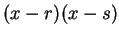 .
.
(j) Yes, this is a ``tiling of the plane''. Notice that it's important to use ``half-open intervals'' so the tiles fit together with no overlap and no holes between.
Note: An example not included that could have been is
(k) There is just one block, consisting of all of . This
does count as a partition.
For Problem Q-3:
(a) The union of the nonzero parts of 1-dimensional subspaces is the nonzero part of the vector space, since every nonzero vector is in the nonzero part of the 1-dimensional subspace it generates.
Any two 1-dimensional subspaces are disjoint except for
0,
since if a nonzero vector  is in both, then both subspaces
consist of the nonzero scalar multiples of and so are
the same.
is in both, then both subspaces
consist of the nonzero scalar multiples of and so are
the same.
(b) Let
 GF
GF . Then
 and so
  has
has
 elements, so the nonzero part of has
  elements. A 1-dimensional subspace is isomorphic to
  and so has
  elements; its nonzero part has
  elements.
Since
elements.
Since
 0 is partitioned as in (a) and the
blocks have equal size, the number of blocks is
0 is partitioned as in (a) and the
blocks have equal size, the number of blocks is
 . (If you don't know how to factor
as a polynomial in , use long division of polynomials.)
. (If you don't know how to factor
as a polynomial in , use long division of polynomials.)
For the case  this gives 7, which checks with the
answer to Problem G-4.
this gives 7, which checks with the
answer to Problem G-4.