


p. 21, Ex. 3.
This problem can be solved by experimenting, but it's better to use an organized approach. I'll list several options.
(i) Just try matrices that have three zeros. You will find
that good solutions are
![$ N = \left[\begin{array}{cc}0&0\\ 1&0\end{array}\right]$](img1.gif) and its
transpose.
and its
transpose.
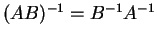
(ii) Notice that  should not be invertible, since a product
of invertible matrices is invertible (rule
should not be invertible, since a product
of invertible matrices is invertible (rule
 ) and the zero matrix is not invertible. Then
doesn't have rank 2 and we also know it doesn't have rank 0
(which would be the zero matrix). So the rank of is 1.
This should help experiments.
) and the zero matrix is not invertible. Then
doesn't have rank 2 and we also know it doesn't have rank 0
(which would be the zero matrix). So the rank of is 1.
This should help experiments.
(ii ) Continuing with the rank 1 idea and recalling a previous
problem,
) Continuing with the rank 1 idea and recalling a previous
problem,
 for column vectors
  .
.
 , which is column
 rowcolumnrow.
The middle row and column multiply to make a
rowcolumnrow.
The middle row and column multiply to make a
 matrix,
which is just a scalar, and it had better be 0 or else
matrix,
which is just a scalar, and it had better be 0 or else  won't be the zero matrix. So just pick any two column vectors
with
won't be the zero matrix. So just pick any two column vectors
with
 (which really says the dot product
of the two is 0) and let
. Example:
(which really says the dot product
of the two is 0) and let
. Example:
![$ v = \left[\begin{array}{c}1\\ 0\end{array}\right]$](img12.gif) ,
,
![$ u = \left[\begin{array}{c}0\\ 1\end{array}\right]$](img13.gif) ; then
; then  above.
(iii) Plan what  should do to standard basis
vectors. If takes
should do to standard basis
vectors. If takes  to
to  and
to
0, then doing twice will take both
standard basis vectors to 0, which says
and
to
0, then doing twice will take both
standard basis vectors to 0, which says
 is the
zero transformation, as hoped. What is ? Its first column
is and its second column is
0, so .
is the
zero transformation, as hoped. What is ? Its first column
is and its second column is
0, so .
(iv) [for later, after you have had the ingredients] If
is the zero matrix, then the eigenvalues of also must obey
 , so the determinant and trace of will be
0. (The trace is the sum of the diagonal entries.) So
should look like
, so the determinant and trace of will be
0. (The trace is the sum of the diagonal entries.) So
should look like
![$ \left[\begin{array}{cc}a&\cdot\\ \cdot&-a\end{array}\right]$](img20.gif) . If
. If  then to make the determinant come out 0 the missing entries should
be
then to make the determinant come out 0 the missing entries should
be  and
and  for some
  . If
. If  then to make the determinant come out 0 the missing entries should
be and 0 either way around. To summarize,
then to make the determinant come out 0 the missing entries should
be and 0 either way around. To summarize,
![$ A = \left[\begin{array}{cc}a&b\\ -a^2/b&-a\end{array}\right]$](img26.gif) (with
(with
 ) or
) or
![$ A =
\left[\begin{array}{cc}0&b\\ 0&0\end{array}\right]$](img28.gif) or
or
![$ A = \left[\begin{array}{cc}0&0\\ b&0\end{array}\right]$](img29.gif) (with ).
(with ).
p. 21, Ex. 4.
I get
![$ E _ 1 = \left[\begin{array}{rrr}1&0&0\\ -2&1&0\\ 0&0&1\end{array}\right]$](img30.gif) ,
,
![$ E _ 2 = \left[\begin{array}{rrr}1&0&0\\ 0&1&0\\ -3&0&1\end{array}\right]$](img31.gif) ,
,
![$ E _ 3 = \left[\begin{array}{rrr}1&0&0\\ 0&\frac 12&0\\ 0&0&1\end{array}\right]$](img32.gif) ,
,
![$ E _ 4 = \left[\begin{array}{rrr}1&1&0\\ 0&1&0\\ 0&0&1\end{array}\right]$](img33.gif) ,
,
![$ E _ 5 = \left[\begin{array}{rrr}1&0&0\\ 0&1&0\\ 0&-3&1\end{array}\right]$](img34.gif) ,
,
![$ E _ 6 = \left[\begin{array}{rrr}1&0&0\\ 0&1&0\\ 0&0&-2\end{array}\right]$](img35.gif) ,
,
![$ E _ 7 = \left[\begin{array}{rrr}1&0&-\frac 12\\ 0&1&0\\ 0&0&1\end{array}\right]$](img36.gif) ,
,
![$ E _ 8 = \left[\begin{array}{rrr}1&0&0\\ 0&1&\frac 12\\ 0&0&1\end{array}\right]$](img37.gif) .
.
Of course, someone else might use some other order of row-reduction and get other matrices.
Notice that the text uses  for elementary matrices, while I
have been using for a matrix in row-reduced echelon form.
for elementary matrices, while I
have been using for a matrix in row-reduced echelon form.
This is really what Theorem 9 on p. 20 is saying for the case of elementary matrices.
p. 21, Ex. 7.
Here we are evidently supposed to do more than just to quote a theorem like the one on Handout S. The more we know, the easier it is to find a good solution. Some methods:
(i) The straightforward method is to write
![$ A = \left[\begin{array}{cc}a&b\\ c&d\end{array}\right]$](img39.gif) and
and
![$ B = \left[\begin{array}{cc}r&s\\ t&u\end{array}\right]$](img40.gif) and solve
and solve  for B in terms
of . Then we can check directly that
for B in terms
of . Then we can check directly that  .
.
Details: As a warmup, think how we would do the problem if
had numbers instead of letters, e.g.,
![$ \left[\begin{array}{cc}3&7\\ 4&2\end{array}\right]
\left[\begin{array}{cc}r&s\\ t&u\end{array}\right] = \left[\begin{array}{cc}1&0\\ 0&1\end{array}\right]$](img43.gif) . This is equivalent to
two separate linear systems:
. This is equivalent to
two separate linear systems:
![$ \left[\begin{array}{cc}3&7\\ 4&2\end{array}\right] \left[\begin{array}{c}r\\ t\end{array}\right] = \left[\begin{array}{c}1\\ 0\end{array}\right]$](img44.gif) and
and
![$ \left[\begin{array}{cc}3&7\\ 4&2\end{array}\right] \left[\begin{array}{c}s\\ u\end{array}\right] = \left[\begin{array}{c}0\\ 1\end{array}\right]$](img45.gif) . They can
be made into a single problem with an augmented matrix to
row-reduce:
. They can
be made into a single problem with an augmented matrix to
row-reduce:
![$ \left[\begin{array}{cccc}3&7&1&0\\ 4&2&0&1\end{array}\right]$](img46.gif) . The answer for
. The answer for  will be the right-hand part after row reduction. This is the same
as a common method of computing an inverse, which is of course what
we're doing. Starting with
will be the right-hand part after row reduction. This is the same
as a common method of computing an inverse, which is of course what
we're doing. Starting with
![$ \left[\begin{array}{cccc}a&b&1&0\\ c&d&0&1\end{array}\right]$](img48.gif) and
row-reducing, we eventually will get
and
row-reducing, we eventually will get
![$ \left[\begin{array}{cccc}1&0&\frac d \Delta&
-\frac b \Delta\\ 0&1& - \frac c \Delta & \frac a \Delta\end{array}\right]$](img49.gif) , where
, where
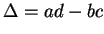 (Greek capital Delta). (If we divide by
 , say, during the calculation then we have to split cases
into and , but the answer will come out the
same either way.)
, say, during the calculation then we have to split cases
into and , but the answer will come out the
same either way.)  itself can't be 0 since there is a
solution. Then we know
itself can't be 0 since there is a
solution. Then we know
![$ B = \left[\begin{array}{cc}\frac d \Delta&
-\frac b \Delta\\ - \frac c \Delta & \frac a \Delta\end{array}\right]$](img53.gif) or more simply,
or more simply,
![$ \frac 1 \Delta \left[\begin{array}{cc}d&-b\\ -c& a\end{array}\right]$](img54.gif) . We can check directly that .
. We can check directly that .
(ii) has to be of rank 2 since  has rank 2 and rank can't
increase under matrix multiplication. So row-reducing we get .
In other words,
has rank 2 and rank can't
increase under matrix multiplication. So row-reducing we get .
In other words,
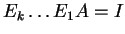 . Multiplying by on
the right we get
. Multiplying by on
the right we get
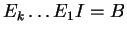 , so
, so
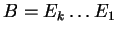 and also we have .
(iii) If then
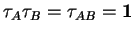 so is one-to-one so the nullity of is 0. Then
the rank of is 2, so is onto. Since
is an isomorphism, it has a two-sided inverse, which is
so is one-to-one so the nullity of is 0. Then
the rank of is 2, so is onto. Since
is an isomorphism, it has a two-sided inverse, which is  .
Then is a two-sided inverse for .
.
Then is a two-sided inverse for .
Note. This problem is related to a simple observation: If
 has both a left inverse
  and a right inverse
  then
then
 . The reason:
 can be thought of as
 and as
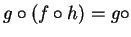 1
1 , so
, so  .
.
In the special case of linear transformations on a finite-dimensional
vector space to itself, a corollary of the dimension theorem was that
if  is one-to-one then is onto, so if has a left
inverse then it has a right inverse also, and so a two-sided
inverse.
is one-to-one then is onto, so if has a left
inverse then it has a right inverse also, and so a two-sided
inverse.
p. 26, Ex. 1. It's simplest to augment with an identity matrix
to keep track of the cumulative effect of the elementary row operations.
The idea is that by doing row operations we are computing  ,
and by doing the same row operations on
,
and by doing the same row operations on ![$ [A\vert I]$](img72.gif) we get
we get ![$ [PA\vert P]$](img73.gif) so we can see
so we can see  as well as the reduced version of .
![$ [A\vert I] = \left[\begin{array}{ccccccc}1&2&1&0&1&0&0\\ -1&0&3&5&0&1&0\\ 1&...
... -\frac 14\\
0&0&1&\frac {11}8&\frac 18& \frac 14& \frac 18\end{array}\right]$](img75.gif) .
.
This says that
![$ PA = \left[\begin{array}{cccc}1&0&0&-\frac 78\\ 0&1&0&-\frac 14\\
0&0&1&\frac {11}8\end{array}\right]$](img76.gif) and
and
![$ P = \left[\begin{array}{ccc}\frac 38& -\frac 14& \frac 38\\
\frac 14& 0& -\frac 14\\ \frac 18& \frac 14& \frac 18\end{array}\right]$](img77.gif) .
.
p. 27, Ex. 5.
Yes, scaling the last three rows by
 respectively and sweeping out columns using the leading
1's, we see that is elementarily equivalent to the
identity matrix and so is invertible.
respectively and sweeping out columns using the leading
1's, we see that is elementarily equivalent to the
identity matrix and so is invertible.
Other ways to see this, for the future:
The determinant of a triangular matrix is the product of the diagonal
entries, so
 , which means is invertible.
The eigenvalues of a triangular matrix are the diagonal entries, and since none are 0 the matrix is nonsingular.
p. 27, Ex. 6.
The rank of is no more than 1, and the rank
of  can't be larger than the maximum of the rank of
and the rank of , so rank
can't be larger than the maximum of the rank of
and the rank of , so rank  = 1. But is
 so if were invertible its rank would have to be 2.
p. 74, Ex. 11.
This problem says to show that is the
zero transformation
 is the zero matrix. Solution:
For ``implies'':
if
 0 for all
  then in particular
 0 for all
  , which is the same as saying that each column of
is the zero vector, i.e., all entries of are 0.
, which is the same as saying that each column of
is the zero vector, i.e., all entries of are 0.
For ``impliedby'':
If is the zero matrix then
 0 for all , which
says is the zero transformation.
0 for all , which
says is the zero transformation.
p. 74, Ex. 12.
Since the range and null space of are identical,
the rank and nullity are the same, say  , and we know
dim
, and we know
dim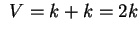 , so
dim
, so
dim is even.
Technically, the simplest example would be to have
 0
0 and let be the zero transformation. A more meaningful example
would be to take
and let be the zero transformation. A more meaningful example
would be to take  (since we know the dimension is even!),
and let
Range
(since we know the dimension is even!),
and let
Range Nullspace span
 . This can
be accomplished by having
. This can
be accomplished by having
 and
and
 0.
In other words,
0.
In other words,
 for
for
![$ A = \left[\begin{array}{cc}0&1\\ 0&0\end{array}\right]$](img100.gif) .
.
p. 84, Ex. 7.
A ``linear operator'' is a transformation on a vector space
to itself. We know linear transformations on
 are all
of the form for a suitable
matrix ,
so we are looking for
matrices
are all
of the form for a suitable
matrix ,
so we are looking for
matrices  with
with
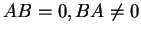 (where 0 means the
zero matrix).
(where 0 means the
zero matrix).
One way is to experiment with matrices that have lots of 0 entries.
For example,
![$ A = \left[\begin{array}{cc}1&0\\ 0&0\end{array}\right]$](img104.gif) ,
,
![$ B = \left[\begin{array}{cc}0&1\\ 0&0\end{array}\right]$](img105.gif) provide
an example.
provide
an example.
Another way is to realize that the nilpotent matrix
and its transpose are often good examples of
bad behavior, so try ,
![$ B = \left[\begin{array}{cc}a&b\\ c&d\end{array}\right]$](img106.gif) and try to
solve for the desired condition. You get an example similar to the
one in the preceding paragraph.
and try to
solve for the desired condition. You get an example similar to the
one in the preceding paragraph.
p. 85, Ex. 1.
 by
by
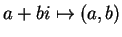 .
.
p. 86, Ex. 4.
We need to set up a correspondence between pairs of indices  (
(
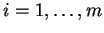 ,
,
 ) and indices running from 1 to
 . In other words, we need to specify an order for the pairs
of indices and say how to list them in that order. Where does
. In other words, we need to specify an order for the pairs
of indices and say how to list them in that order. Where does
 go?
go?
One way is to list the matrix by row 1, then row 2, etc.:
 , etc.
Each new row adds  to the position, but row 1 adds nothing,
so the contribution of the row index is off by 1. We get that
the position of in the list is
to the position, but row 1 adds nothing,
so the contribution of the row index is off by 1. We get that
the position of in the list is
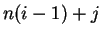 . Then
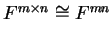 by having each matrix
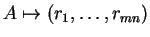 given by
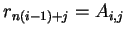 for
,
.
for
,
.
p. 86, Ex. 6.
For ``
 '':
If
'':
If  and
and  are isomorphic we know that a basis of one
maps to a basis of the other, so they have the same dimension.
are isomorphic we know that a basis of one
maps to a basis of the other, so they have the same dimension.
For ``
 '':
If they have the same dimension, say , we know they are
both isomorphic to
'':
If they have the same dimension, say , we know they are
both isomorphic to  and so are isomorphic to each other.
For Problem Q-1:
(a)
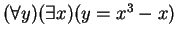 .
.
(b)
 .
.
(c)
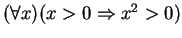 .
.
(d)
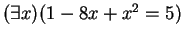 .
.
(e)
 and
and 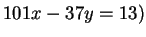 .
.
(f)
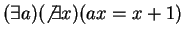 .
.
(g)
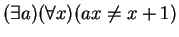 (or in other words,
 n o t
n o t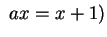 ).
).
Note: In logic,  and
and  are called quantifiers.
is the universal quantifier (since it says something is
true universally) and is the existential quantifier.
are called quantifiers.
is the universal quantifier (since it says something is
true universally) and is the existential quantifier.
Normally we don't write mathematics in such a condensed form, but it is important always to notice what the underlying quantification is.