


A permutation is a cycle if some symbols go in a single cycle when the permutation is repeated, while the other symbols stay fixed.
Example:
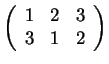 is
a cycle since we have
is
a cycle since we have
 .
.
For short such a cycle is written
 , again
meaning
.
, again
meaning
.
On five symbols, one cycle is
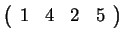 , meaning
 and
and
 . A
cycle of length
. A
cycle of length  is called a -cycle. A 2-cycle is
called a transposition.
is called a -cycle. A 2-cycle is
called a transposition.
Proposition. Any permutation on  symbols can be
written as a product of disjoint (non-overlapping) cycles.
For example, one permutation in
symbols can be
written as a product of disjoint (non-overlapping) cycles.
For example, one permutation in  is
is  .
.
Since disjoint cycles commute, the order doesn't make a difference.
Problem
V-12. Do  and
and  commute?
Problem
V-13. Write
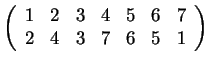 as a
product of disjoint cycles. (Omit 1-cycles.)
as a
product of disjoint cycles. (Omit 1-cycles.)
Problem
V-14. Write out the multiplication table of  using cycle notation.
The elements are
using cycle notation.
The elements are
 (meaning the identity transformation),
3-cycles, and 2-cycles (transpositions).
(meaning the identity transformation),
3-cycles, and 2-cycles (transpositions).