


Definition. A binary relation on a set  is any rule by which
some pairs are declared to be related and others not related3.
Some examples for
is any rule by which
some pairs are declared to be related and others not related3.
Some examples for
 are (i) the relation
  ,
(ii) the relation
,
(ii) the relation  , (iii) the equality relation (where
elements are related only to themselves), and (iv) the
, (iii) the equality relation (where
elements are related only to themselves), and (iv) the  relation. If the name of the relation is
  , we can write
 to mean
  and
and  are related by .
Some useful properties that a relation can have are
as follows. (As usual, it is understood that they mean for all
, or for all  , etc.)
(1)  |
`` is reflexive'' |
(2)
 |
`` is symmetric'' |
(3) and
 |
`` is transitive'' |
Problem V-15. For each of examples (i) through (iv), which of properties (1), (2), (3) hold?
Definition. A relation is an equivalence
relation if all three of (1), (2), (3) hold.
Problem
V-16. Which of the following examples (i)-(xi) are equivalence
relations on ? (Explain why or why not.)
(v)
 and means
  is even.
(vi) is any set,  is any set,
 is any function,
and
is any function,
and
 means
means
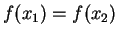 .
.
(vii)
 , there is a subspace
  of , and
means
of , and
means
 .
.
(viii)
 Mats
Mats and
and  means that
  is row-equivalent to
  ; in other words, and have
the same row space, which is the same as saying they have the
same row-reduced echelon form.
; in other words, and have
the same row space, which is the same as saying they have the
same row-reduced echelon form.
(ix)
Mats (square!) and is
``similarity''
(square!) and is
``similarity''  , where
  means
means
 for some invertible
 matrix
(x) is any set and every two elements are related by .
(xi) is any set, subsets  partition , and
means that and are in the same block.
partition , and
means that and are in the same block.
Problem
V-17. What is wrong with the following ``proof'' that a symmetric, transitive
relation is reflexive? ``If then also  by symmetry,
and then and together imply by
transitivity''.
by symmetry,
and then and together imply by
transitivity''.
The real purpose of equivalence relations is to be able to describe partitions easily, as in (xi) above:
Theorem. Suppose is an equivalence relation on a set .
For each  , define the block of to be
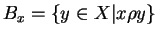 . Then (i) the distinct blocks of this
kind form a partition of , and (ii) the equivalence
relation derived from this partition as in (xi) above is
.
. Then (i) the distinct blocks of this
kind form a partition of , and (ii) the equivalence
relation derived from this partition as in (xi) above is
.
Thus each equivalence relation corresponds to a partition and vice-versa. Notice that in the theorem, two different elements may give the same block, but we use just one copy of each block.
A common terminology is to call the blocks ``equivalence classes'', but this conflicts with the word ``classes'' as it is used in set theory.
Problem V-18. Prove the theorem.
Problem V-19. Where possible, tie the examples of equivalence relations given above to the examples of partitions from Problem Q-2.
Problem
V-20. Prove that for any integer  , ``congruence modulo
 '' is an equivalence relation. Specifically,
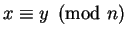 means that
  (i.e., divides
 , meaning that there is some
 with
with
 ). Use any reasonable properties of integer division.
Remember, you can divide into 0 but not by 0.
). Use any reasonable properties of integer division.
Remember, you can divide into 0 but not by 0.