


Definition. A permutation of a set  is a one-to-one
correspondence on
is a one-to-one
correspondence on
 .
.
Sometimes we are interested in permutations of a specific set,
such as rows of a matrix, as in Problem V-![[*]](/lib/latex2html-icons/crossref.gif) .
It is important, though, to understand the structure of various
permutations on
.
It is important, though, to understand the structure of various
permutations on  symbols for each specific value of ,
and for that it makes little difference what the set is.
Therefore we often use
symbols for each specific value of ,
and for that it makes little difference what the set is.
Therefore we often use
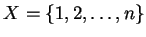 as a set of
symbols to permute.
as a set of
symbols to permute.
The set of permutations on
 is denoted
 , the symmetric group on symbols1.
For example, there are six permutations on three symbols, so
, the symmetric group on symbols1.
For example, there are six permutations on three symbols, so
 has six elements. In general, has
  elements.
Temporarily, let's describe permutations by writing the symbols each with its image beneath. For example,
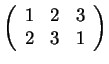 means the permutation for which
 .
.
Definition. Permutations are multiplied by taking their composition.
Problem
V-11. What is
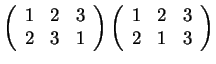 ?
?
(Method: We are composing functions  and
and  . Find
 and then write the answer in the
matrix-like form2.)
and then write the answer in the
matrix-like form2.)