


A partition of a set  is a list of subsets
 (for some
  ) so that
(i)
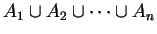 is all of .
(ii) The  are pairwise disjoint, i.e.,
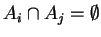 for
for  .
.
The subsets are called ``blocks'' or ``classes'' (an older term).
More generally, it is OK to have infinitely many blocks, in
which case (i) can be expressed as
 .
.
Problem Q-2. In each of the following examples, say whether the subsets form a partition, and if they are not, say why not. (If they are a partition, no proof is needed.)
(a) is the set of seven plants in Problem G-9 and the blocks
are the ones the problem asks for.
(b) is
 and the blocks are a 2-dimensional subspace and
all the planes parallel to it.
and the blocks are a 2-dimensional subspace and
all the planes parallel to it.
(c) is
and the blocks are a 1-dimensional subspace
and all the lines parallel to it.
(d) is
and the blocks are all the 1-dimensional subspaces.
(e) is
 and there are two blocks, one consisting of all
even integers and the other consisting of all odd integers.
and there are two blocks, one consisting of all
even integers and the other consisting of all odd integers.
(f) is
and there are ten blocks, each consisting of
integers that are congruent to each other modulo 10. For example,
one of the blocks is
 .
.
(g) is any set and the blocks are all the singleton subsets
(1-element subsets).
(h)
 is a function between sets, and the blocks are the
inverse images of elements in the image [range] of
is a function between sets, and the blocks are the
inverse images of elements in the image [range] of  , in other words,
the subsets
, in other words,
the subsets
 for
for
 image
image .
.
(i) is
Pols (polynomials of all degrees) and for each
 there is a block
 Pols
Pols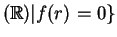 .
.
(j)
 and for each
 there is a block
 .
.
Problem
Q-3. (a) Show that in a vector space  , the nonzero part
 0
0 (meaning with
 0 omitted) is partitioned by the nonzero parts of
the 1-dimensional subspaces of .
0 omitted) is partitioned by the nonzero parts of
the 1-dimensional subspaces of .
(b) If is a 3-dimensional vector space over  , find
a formula for the number of 1-dimensional subspaces of .
, find
a formula for the number of 1-dimensional subspaces of .
(Method: Use (a). How large are the 1-dimensional subspaces?
Your answer will be a polynomial in  . Does it check with
the solution to Problem J-5? As mentioned before, will be
a power of a prime, but that fact isn't needed for this problem.)
. Does it check with
the solution to Problem J-5? As mentioned before, will be
a power of a prime, but that fact isn't needed for this problem.)