


In mathematics, many assertions involve the idea of ``for all''. Others involve the idea of ``there exists''. Still others have both as ingredients.
``For all  '' has the shorthand form
 .
.
``There exists '' has the shorthand form
 .
.
There are many ways to express these two concepts in English but you can learn to recognize them.
Here are some examples of statements that can be re-expressed in a shorter form using these ideas. They all apply to real numbers, which we won't mention explicitly.
Example (i): ``For any  there is an whose square is
  '' becomes
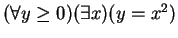 .
.
Example (ii): ``Any nonnegative real number is in the range of the squaring
function  .'' becomes the same as (i).
Example (iii): ``Given any with
 there is an
so that
there is an
so that  lies on the circle
 '' becomes
 .
.
The ingredients in these mathematical ``sentences'' (assertions)
are  ,
,  , variable letters, ``and'', ``or'', ``not'',
 , inequalities,
 , and parentheses. If we
were talking about sets we would use
, and parentheses. If we
were talking about sets we would use  also. Some of
these ingredients can be re-expressed using others, but it's
easier just to use them all. For ``not '' you can use
also. Some of
these ingredients can be re-expressed using others, but it's
easier just to use them all. For ``not '' you can use  ,
etc.
,
etc.
Problem Q-1. Write each of these in shorter form as in the examples above.
(a) The range of the function
 is all numbers.
(b) The real numbers obey the law 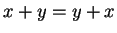 .
.
(c) If a number is positive so is its square.
(d) There is a solution to the equation
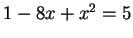 .
.
(e) It is possible to find and so that
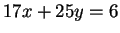 and
and
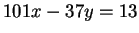 .
.
(f) For at least one  , the equation
  has no solution.
(For ``has no'' you can use
has no solution.
(For ``has no'' you can use
 .)
.)
(g) Re-do (f) using the idea that ``there does not exist with
property  '' is the same as as ``for all we have not-''.
(So it isn't ever really necessary to use
'' is the same as as ``for all we have not-''.
(So it isn't ever really necessary to use
 .)
.)
(You are not asked to prove any statements or solve for any answers; just restate them.)