


Problem Q-4. The Euclidean algorithm is an efficient way of finding the greatest common divisor of two integers: Given two positive integers such as 30 and 56, replace the larger one by its remainder after division by the smaller one, and keep repeating this process until one of them is 0. Then the gcd is the other number left. For example, 30 and 56 become 30 and 26, which become 4 and 26, which become 4 and 2, which become 0 and 2, so the gcd is 2.
(a) Explain why this works. (Method: If the integers are  and
and  with
with  , if you divide by and
get quotient
, if you divide by and
get quotient  and remainder
  , then
 .
Show that the set of positive integers that divide both
and is exactly the same as the set of positive integers
that divide both and . How about the gcd of 0 and
.
Show that the set of positive integers that divide both
and is exactly the same as the set of positive integers
that divide both and . How about the gcd of 0 and
 , once you have reached that stage? If you wish, you may
use the notation common in number theory:
, once you have reached that stage? If you wish, you may
use the notation common in number theory:  means ``
divides ''. Note: It is OK to divide into 0 but not by 0.)
means ``
divides ''. Note: It is OK to divide into 0 but not by 0.)
(b) Find the gcd of 91 and 221 this way.
Problem
Q-5. Decide which two numbers  between 30 and 60
with
between 30 and 60
with  will take the most steps of the Euclidean
algorithm to get their gcd. (Give your reasoning.)
will take the most steps of the Euclidean
algorithm to get their gcd. (Give your reasoning.)
Problem Q-6. Solving for the gcd as a linear combination.
It is a theorem about integers that if
 gcd
gcd then
there exist integers and
then
there exist integers and  with
with
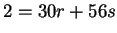
 . For
example, there should be and so
. For
example, there should be and so
 .
.
Here is a method to find and by getting more
information out of the Euclidean algorithm. First, put the two
numbers as a column of a matrix augmented by the identity matrix:
![$ \left[\begin{array}{rrr}56&1&0\\ 30&0&1\end{array}\right]$](img70.gif) . Then row-reduce as best you can
using integer operations only, as follows. At each step,
subtract off an integer multiple of one row from the other row
so that the left columns follow the Euclidean algorithm. Do
not scale rows. You don't need to swap rows either.
. Then row-reduce as best you can
using integer operations only, as follows. At each step,
subtract off an integer multiple of one row from the other row
so that the left columns follow the Euclidean algorithm. Do
not scale rows. You don't need to swap rows either.
![$ \left[\begin{array}{rrr}56&1&0\\ 30&0&1\end{array}\right] \rightsquigarrow \l...
...\rightsquigarrow
\left[\begin{array}{rrr}2&7&-13\\ 0&-15&28\end{array}\right]$](img71.gif) .
.
Now in the last matrix look at the row that has the gcd. This
row is in the row space of the original matrix. With what
coefficients? Easy--from the identity matrix part, we see that
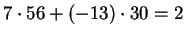
this row with 2 is 7 times the first row of the original matrix
minus 13 times the second row. But this says
 .
.
As a check on arithmetic, since these row operations do not
affect determinants, along the way the determinant of the
right-hand
 submatrix should always be 1.
Do this procedure to express the gcd of 91 and 221 as an integer linear combination of these two integers.
(You are not asked to prove the theorem, but this procedure itself really amounts to the proof. Be careful about which coefficient goes with 91 and which with 221, and check your answer.)
Problem
Q-7.  is a prime. Find the multiplicative inverse
of
is a prime. Find the multiplicative inverse
of  in the field
 .
.
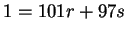
(Method: This sounds difficult but it's not. The gcd of a
prime  and a number not divisible by is 1, so you can
find and with
and a number not divisible by is 1, so you can
find and with
 . In
,
101 is the same as 0 so this expression says
. In
,
101 is the same as 0 so this expression says
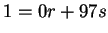 ,
so is the multiplicative inverse. If is among
0 to
,
so is the multiplicative inverse. If is among
0 to  , you'll need to change it by
  a
multiple of .)
a
multiple of .)