


For Problem V-15:
(i) For `` '': transitive
(ii) For `` '': reflexive, transitive
(iii) For `` '': all three, so equality is an equivalence relation
(iv) For `` '': symmetric
For Problem V-16:
All of them are equivalence relations:
(v) is reflexive since  , which is even; symmetric
since
, which is even; symmetric
since  is even implies
  is even; transitive since
and
is even; transitive since
and  both even imply
 is
even.
is
even.
(vi) is reflexive since
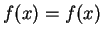 ; symmetric since
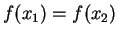 implies
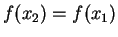 ; transitive since
if
; transitive since
if  has equal values at
  and
and  and
equal values at and
and
equal values at and  then has equal
values at and .
then has equal
values at and .
(vii) is reflexive since
 0
0 ; symmetric since
  implies
 ; transitive since and
  imply
imply
 .
.
(viii) is reflexive since  has the same row space as itself;
symmetric since if and
has the same row space as itself;
symmetric since if and  have the same row space then
and have the same row space; transitive since if and
have the same row space and and
have the same row space then
and have the same row space; transitive since if and
have the same row space and and  have the same row space
then and have the same row space.
have the same row space
then and have the same row space.
(ix) is reflexive since
 so
so  ;
symmetric since
;
symmetric since  means
means
 for some invertible
 , and if we multiply on both sides of the equation by on
the left and
, and if we multiply on both sides of the equation by on
the left and  on the right then we get
 ,
which is the same as
,
which is the same as
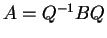 for
for
 , giving
 ; transitive since and
  imply
and
imply
and
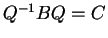 for some invertible
and
for some invertible
and  , so that
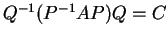 , which is the same
as
, which is the same
as
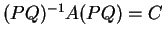 , so
, so  .
.
(x) is all three since any assertion that two elements are related is true, and the three properties consist of such assertions.
(xi) is reflexive since any element is in the same block as itself;
symmetric since if  and
and  are in the same block then
and are in the same block; transitive since if and
are in the same block and and
are in the same block then
and are in the same block; transitive since if and
are in the same block and and  are in the same block then
and are in the same block.
are in the same block then
and are in the same block.