


For Problem V-11:
Starting from the right,
 , so the answer is
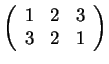 .
.
For Problem V-12:
 since going right to left,
 .
.
 since
since
 . Therefore they do not commute.
Since the particular symbols do not really matter and since
 , we see that two transpositions that have just
one symbol in common do not commute; instead their products are
give distinct 3-cycles.
, we see that two transpositions that have just
one symbol in common do not commute; instead their products are
give distinct 3-cycles.
For Problem V-13:
(This problem had a misprint: the last 4 should be 1.)
 ,
,
 , and
, and
 , so the ``cycle decomposition'' is
 .
.
For Problem V-14:
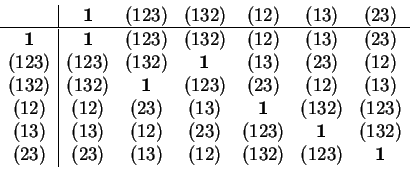
Note: For  the table would be
 , and
some elements would be non-cycles such as
, and
some elements would be non-cycles such as  .
.