


For Problem W-1:
Remember, for
 GF
GF , any
, any  -dimensional vector space
over
-dimensional vector space
over  has
has  elements, even if the vector space is a
subspace of some sort. Here we are working inside
elements, even if the vector space is a
subspace of some sort. Here we are working inside  .
.
Following the suggestion, for the first row we just need to
choose a nonzero vector, so there are  possible choices.
The first row spans a 1-dimensional subspace of
with elements.
possible choices.
The first row spans a 1-dimensional subspace of
with elements.
For the second row, we can choose any triple that avoids this
1-dimensional subspace, so there are  possibilities
for the second row. The first two rows together are linearly
independent, so together they span a 2-dimensional subspace of
with
possibilities
for the second row. The first two rows together are linearly
independent, so together they span a 2-dimensional subspace of
with  elements.
For the third row, we can choose any triple that avoids this
2-dimensional subspace, so there are  possibilities.
Putting these together, we have

possible matrices. (It is OK to multiply here even though each choice depends on the preceding choices, because the number of possibilities for each choice does not depend on the preceding choices.)
For  this gives
 invertible matrices.
For Problem W-2:
(a) One way:
![$ e ^ D = I + {\frac{\displaystyle 1}{\displaystyle 1!}} D + {\frac{\displaystyl...
...}\end{array}\right] =
\left[\begin{array}{rr}e&0\\ 0&e^{-1}\end{array}\right]$](img124.gif) .
.
Although this is just one example, you can see that the general
principle is this: If  is a diagonal matrix with diagonal
entries
is a diagonal matrix with diagonal
entries
 then
then  is a diagonal
matrix with diagonal entries
is a diagonal
matrix with diagonal entries
 .
.
Of course, this idea works for other functions in place of  .
This is another illustration of how the diagonal entries of a
diagonal matrix work independently of one another.
.
This is another illustration of how the diagonal entries of a
diagonal matrix work independently of one another.
(b) Notice that the powers of  are
are
 .
Then
.
Then
 . Collecting terms we get
![$ e ^ {tJ} = (1 - {\frac{\displaystyle 1}{\displaystyle 2!}}t^2 + {\frac{\displa...
... J = \left[\begin{array}{cc}\cos t& -\sin t\\ \sin t& \cos t\end{array}\right]$](img133.gif) , which
we recognize as the rotation matrix
, which
we recognize as the rotation matrix
 with
with
 .
.
Note. This is a matrix version of Euler's formula about complex
numbers:
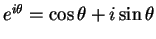 , the
complex number representing a rotation by
, the
complex number representing a rotation by  . Putting
 gives the famous formula
 .
You might have seen this in Math 33B. Complex numbers are the
subject of Math 132.
.
You might have seen this in Math 33B. Complex numbers are the
subject of Math 132.
(c) This is easier. By the Golden Rule, the powers of  are obtained by successively ``sliding the rows down'' and its fourth
power is the zero matrix. Therefore
are obtained by successively ``sliding the rows down'' and its fourth
power is the zero matrix. Therefore
 zero matrices, so we get
![$ e ^ {tN _ 4} = \left[\begin{array}{cccc}1&0&0&0\\ t&1&0&0\\ \frac 12 t^2&t&1&0\\
\frac 16 t^3&\frac 12 t^2&t&1\end{array}\right]$](img142.gif)
For Problem W-3:
In each case we want to express  as a linear
combination of
as a linear
combination of  and
and  . Although it is
possible to extend the basis and work in
. Although it is
possible to extend the basis and work in
 , it seems
simplest just to stay in
, it seems
simplest just to stay in  and use unknown coefficients.
By the Golden Rule,
and use unknown coefficients.
By the Golden Rule,  rotates
  downwards one position.
For (a):
![$ v _ 1 = \left[\begin{array}{r}1\\ -1\\ 0\end{array}\right]$](img150.gif) ,
,
![$ T(v _ 1) = \left[\begin{array}{r}0\\ 1\\ -1\end{array}\right] = r \left[\beg...
...\ 0\end{array}\right] + s \left[\begin{array}{r}1\\ 0\\ -1\end{array}\right]$](img151.gif)
![$ v _ 2 = \left[\begin{array}{r}1\\ 0\\ -1\end{array}\right]$](img152.gif) ,
,
![$ T(v _ 2) = \left[\begin{array}{r}-1\\ 1\\ 0\end{array}\right] = t \left[\beg...
...\ 0\end{array}\right] + u \left[\begin{array}{r}1\\ 0\\ -1\end{array}\right]$](img153.gif)
This gives three equations in  and the same for
 , so use the two easiest equations in each case.
We get
, so use the two easiest equations in each case.
We get  ,
,  ,
,  ,
,  .
So
.
So
![$ M = \left[\begin{array}{rr}r&t\\ s&u\end{array}\right] = \left[\begin{array}{rr}-1&-1\\ 1&0\end{array}\right]$](img159.gif) .
.
As a check,  is a rotation by
 , so
, so
 .
Therefore we should expect
.
Therefore we should expect  , which does turn out to be
true. (Although we haven't discussed it,
, which does turn out to be
true. (Although we haven't discussed it,  imitates
insofar as such algebraic properties are concerned.)
imitates
insofar as such algebraic properties are concerned.)
For (b):
,
![$ T(v _ 1) = \left[\begin{array}{r}0\\ 1\\ -1\end{array}\right] = r \left[\beg...
...\ 0\end{array}\right] + s \left[\begin{array}{r}1\\ 1\\ -2\end{array}\right]$](img164.gif)
![$ v _ 2 = \left[\begin{array}{r}1\\ 1\\ -2\end{array}\right]$](img165.gif) ,
,
![$ T(v _ 2) = \left[\begin{array}{r}-2\\ 1\\ 1\end{array}\right] = t \left[\beg...
...\ 0\end{array}\right] + u \left[\begin{array}{r}1\\ 1\\ -2\end{array}\right]$](img166.gif)
This gives three equations in and the same for
, so again use the two easiest equations in each case.
We get
 ,
,
 ,
,
 ,
,
 . So
. So
![$ M = \left[\begin{array}{rr}r&t\\ s&u\end{array}\right] = \left[\begin{array}{rr}-\frac 12&-\frac 32\\ \frac 12& -\frac 12\end{array}\right]$](img171.gif) .
.
Again, it can be checked that .
For Problem W-4:
(a) In the opposite direction, to go from the standard basis to
the given nonstandard basis the matrix is
![$ A = \left[\begin{array}{rr}1&1\\ 1&-1\end{array}\right]$](img172.gif) .
Then the answer is
.
Then the answer is
![$ M = A^{-1} = \frac 1{-2} \left[\begin{array}{rr}-1&-1\\ -1&1\end{array}\right]
= \frac 12 \left[\begin{array}{rr}1&1\\ 1&-1\end{array}\right]$](img173.gif) .
.
As a check,
![$ \frac 12 \left[\begin{array}{rr}1&1\\ 1&-1\end{array}\right]\left[\begin{array}{r}1\\ 1\end{array}\right] = \left[\begin{array}{r}1\\ 0\end{array}\right]$](img174.gif) and
and
![$ \frac 12 \left[\begin{array}{rr}1&1\\ 1&-1\end{array}\right]\left[\begin{array}{r}1\\ -1\end{array}\right] = \left[\begin{array}{r}0\\ 1\end{array}\right]$](img175.gif) .
.
(b) Following the suggestion,  is as in part (a) and
![$ B =
\left[\begin{array}{rr}1&3\\ 2&4\end{array}\right]$](img176.gif) , giving
, giving
![$ M = B A^{-1} = \left[\begin{array}{rr}2&-1\\ 3&-1\end{array}\right]$](img177.gif) .
Check:
.
Check:
![$ \left[\begin{array}{rr}2&-1\\ 3&-1\end{array}\right] \left[\begin{array}{r}1\\ 1\end{array}\right] = \left[\begin{array}{r}1\\ 2\end{array}\right]$](img178.gif) ,
,
![$ \left[\begin{array}{rr}2&-1\\ 3&-1\end{array}\right] \left[\begin{array}{r}1\\ -1\end{array}\right] = \left[\begin{array}{r}3\\ 4\end{array}\right]$](img179.gif) ,
,
An alternate method: We want with
![$ M \left[\begin{array}{r}1\\ 1\end{array}\right] =
\left[\begin{array}{r}1\\ 2\end{array}\right]$](img180.gif) and
and
![$ M \left[\begin{array}{r}1\\ -1\end{array}\right] = \left[\begin{array}{r}3\\ 4\end{array}\right]$](img181.gif) . We can put
these together using the idea that ``columns of the matrix on the
right work independently'' in a matrix product:
. We can put
these together using the idea that ``columns of the matrix on the
right work independently'' in a matrix product:
![$ M \left[\begin{array}{rr}1&1\\ 1&-1\end{array}\right] = \left[\begin{array}{rr}1&3\\ 2&4\end{array}\right]$](img182.gif) . This says
. This says  with
with  as in the first solution. Now we solve by
multiplying both sides on the right by
as in the first solution. Now we solve by
multiplying both sides on the right by  , again getting
the solution
, again getting
the solution
 .
.