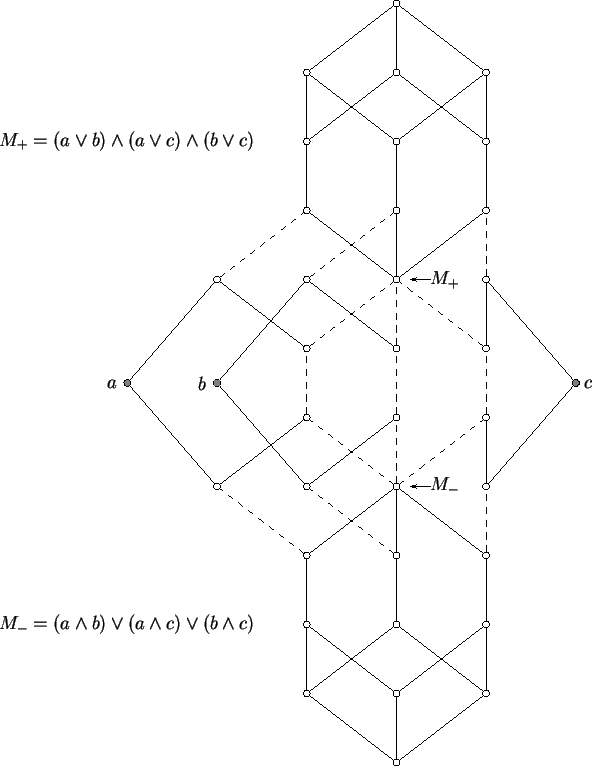
#1. In a diagram of the free distributive lattice
FDL (Figure
 ![[*]](/lib/latex2html-icons/crossref.gif) ), if the generators are
), if the generators are
 you can see that
 .
.
Once it is known that this lattice is indeed a free distributive lattice on three generators, then it follows that this law holds in all distributive lattices:

#2. The free Boolean algebra
FBA, corresponding to a Venn
diagram with three circles. It has 8 atoms and 256 elements.
#3. The free modular lattice
FML shown in Figure .
It has 28 elements.
#4. The free lattice
FL shown in Figure .
It is infinite. Dashed lines represent infinitely many elements not shown.
#5. The free abelian group on  generators is
Z
generators is
Z .
.
#6. The free group
FG consists of all finite expressions
such as
consists of all finite expressions
such as
 , with appropriate equalities.
#7. Every vector space is free, with generators being any basis.
#8. For a given type  , the term algebra
 is the set of all -ary terms of type , with operations
being formal compositions. The generators are the variable symbols
is the set of all -ary terms of type , with operations
being formal compositions. The generators are the variable symbols
 .
.