


There are many examples in mathematics where from one object
 one can construct another kind of object
  . For example,
with a Boolean algebra there is associated a topological space
(its prime ideal space), and with a topological space there is associated
its homology group. These constructions extend to maps between the
objects and have reasonable properties for maps. However, upon closer
examination it can be seen that there are really two kinds:
. For example,
with a Boolean algebra there is associated a topological space
(its prime ideal space), and with a topological space there is associated
its homology group. These constructions extend to maps between the
objects and have reasonable properties for maps. However, upon closer
examination it can be seen that there are really two kinds:
Definition. For categories  and
and  , a
covariant functor
, a
covariant functor  from to consists of
(i) for each object
 , an object
 , and
, and
(ii) for each
 and morphism
 Morph
Morph , a
morphism
, a
morphism
 Morph
Morph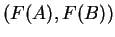 ,
,
with the properties
(a)
 (whenever
 makes sense) and
(b)
 1
1 1
1 for each
.
for each
.
An example is the fundamental-group functor  .
Here is the category of groups; the objects of are
pairs
.
Here is the category of groups; the objects of are
pairs  consisting of a topological space
  and a
designated point in , and the morphisms of are
continuous functions that take designated points to designated
points.
and a
designated point in , and the morphisms of are
continuous functions that take designated points to designated
points.  is the fundamental group
 consisting of equivalence classes of loops at
  in .
in .
A contravariant functor is defined similarly, except that in (ii)
we have
Morph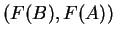 and in (a)
 . An example is the prime-ideal-space functor from
Boolean algebras to topological spaces.
. An example is the prime-ideal-space functor from
Boolean algebras to topological spaces.
For a functor from to and a functor
 from to
  , the result of following
by is again a functor, which will be covariant if
both and are covariant or both and are
contravariant.
, the result of following
by is again a functor, which will be covariant if
both and are covariant or both and are
contravariant.