


Definition. A category consists of
(i) a class  (whose members are called objects), together with
(ii) for each
 , a set
Morph
, a set
Morph (whose members are called
morphisms), and
(whose members are called
morphisms), and
(iii) for each
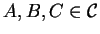 , an operation
  between morphisms,
so that for
between morphisms,
so that for
 Morph and
 Morph
Morph ,
,
 Morph
Morph is defined,
with the properties
(a)
 for morphisms
between successive objects, and
for morphisms
between successive objects, and
(b) for each
 there is an element
1
there is an element
1 Morph
Morph such that
1
such that
1 and
and
 1
1 for all
Morph and
Morph
for all
Morph and
Morph , for any
 .
.
In most familiar examples, the objects are sets,
the morphisms are functions, and is composition (written
composing to the right). The examples
(1), (2), (3) are of this kind, but not all useful categories are.
We usually say ``the category '' with the associated
morphisms and composition understood.
Exercise. Define what it should mean for two objects in a
category to be isomorphic. Solution.  means there
exist morphisms
Morph and
Morph such that
means there
exist morphisms
Morph and
Morph such that
 1
1 and
and
 1
1 .
.