


Problem
N-1. (a) On a sketch of
2 , indicate two elements
that generate
2 as a Boolean algebra. (b) Choose a third
element at the same level as your two generators, and express it
in Boolean normal form in terms of the generators.
, indicate two elements
that generate
2 as a Boolean algebra. (b) Choose a third
element at the same level as your two generators, and express it
in Boolean normal form in terms of the generators.
Problem
N-2. In the examples of §![[*]](/lib/latex2html-icons/crossref.gif) , which are necessarily complete?
Which are necessarily atomic?
, which are necessarily complete?
Which are necessarily atomic?
Problem
N-3. Prove Propositions 1 through 4 of § regarding Boolean
rings.
Problem
N-4. Decide which of the examples in § are atomic,
which are atomless, and which (if any) are neither.
Problem
N-5. Let  be a countably infinite set.
(a) Show that
Pow contains a chain isomorphic to the
chain
R of reals.
contains a chain isomorphic to the
chain
R of reals.
(b) Show that
Pow contains an uncountable antichain of
elements whose pairwise meets are finite subsets of .
Problem
N-6. (a) Show that if  is an atom of a Boolean lattice
  and
and
 , then either
  or
or
 , but not both.
(b) Show that in a complete Boolean lattice , any atom
is completely join-prime (or sup-prime); in other words,
 implies
  for some
  . (Suggestion:
Somehow use
. (Suggestion:
Somehow use  .)
.)
Problem
N-7. Prove this representation theorem: Any atomic
complete Boolean lattice is isomorphic to
Pow for some
set . (A lattice is said to be atomic if every element is
the  of a set of atoms.)
(Notice that most of our representation theorems have used some
subsets of a set; this representation theorem uses all subsets.
Alternatively, this theorem can be regarded as a characterization of the
lattices
Pow--they are the atomic complete Boolean lattices.)
Problem
N-8. Let  be a Boolean lattice with prime ideal
space
be a Boolean lattice with prime ideal
space  . Each lattice property of should be
reflected in some topological property of . Here is
one example: Show that is atomic if and only if the
isolated points of form a topologically dense
subset.
. Each lattice property of should be
reflected in some topological property of . Here is
one example: Show that is atomic if and only if the
isolated points of form a topologically dense
subset.
(An isolated point in a topological space is a point that is open, as a singleton. A subset is dense if its closure is the whole space.)
Problem
N-9. Let be a Boolean lattice. Show that
Open Ideals
 , where
Open
, where
Open denotes the lattice of open sets of a topological space.
Problem
N-10. As discussed in class, if
 is a homomorphism of
Boolean algebras, then there is a corresponding continuous map
is a homomorphism of
Boolean algebras, then there is a corresponding continuous map
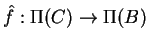 , and if
 is a continuous map
between Boolean spaces, then there is a corresponding
homomorphism
is a continuous map
between Boolean spaces, then there is a corresponding
homomorphism
 Clopen
 Clopen of
Boolean algebras.
Clopen of
Boolean algebras.
Invent and state definitions for  and
and
 (without writing the proof that they make sense) and then
prove one of the two assertions in the following Proposition:
(without writing the proof that they make sense) and then
prove one of the two assertions in the following Proposition:
Proposition.
 and
and
 , up to the identifications of Boolean algebras or Boolean
spaces with their ``double duals1.''
, up to the identifications of Boolean algebras or Boolean
spaces with their ``double duals1.''
Problem N-11. Show that any two countable, atomless Boolean algebras are isomorphic.
(A Boolean algebra is atomless if (surprise!) it has no atoms.
An example of a countable, atomless Boolean algebra is
FBA , the free Boolean algebra on countably
many generators, which can be constructed by first making
FBA
, the free Boolean algebra on countably
many generators, which can be constructed by first making
FBA FBA
FBA FBA
FBA using
Venn diagrams and then taking their union--all the subsets you
get at all stages. Another example is
Clopen
using
Venn diagrams and then taking their union--all the subsets you
get at all stages. Another example is
Clopen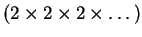 , where
  means
means  as a
discrete topological space; this is the same as the lattice of
all subsets of
as a
discrete topological space; this is the same as the lattice of
all subsets of
 that are describable by
referring only to finitely many coordinates, for example, ``the
subset consisting of all sequences whose second and fourth
entries are either 1 and 0 or 0 and 1''.)
that are describable by
referring only to finitely many coordinates, for example, ``the
subset consisting of all sequences whose second and fourth
entries are either 1 and 0 or 0 and 1''.)