


Definition. A Boolean ring is a ring in which every element is idempotent.
Examples.
 as a ring.
 as a ring (
 ).
).
 , made into a ring by letting multiplication
be
, made into a ring by letting multiplication
be  , addition be the symmetric difference
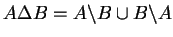 , and 0 be the empty set.
 , the subring of
Pow
consisting of the finite subsets of .
, the subring of
Pow
consisting of the finite subsets of .
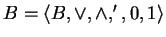 , the ring
 obtained by
defining
obtained by
defining  to be
to be
 and
and  to be
to be
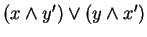 , the Boolean-algebra analogue of the symmetric
difference.
, the Boolean-algebra analogue of the symmetric
difference.
All these examples except ![[*]](/lib/latex2html-icons/crossref.gif) . are Boolean rings with 1.
. are Boolean rings with 1.
Proposition 1. Any Boolean ring is of characteristic
two (i.e., obeys  for all
  ).
).
Proposition 2. Any Boolean ring is commutative.
Proposition 3. Any Boolean ring with 1 can be made into a Boolean
algebra by defining
 ,
,
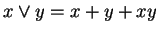 ,
and
,
and  .
.
Proposition 4. For a Boolean algebra  , a subset is a lattice
ideal if and only if it is a ring ideal with respect to the resulting
ring structure.
, a subset is a lattice
ideal if and only if it is a ring ideal with respect to the resulting
ring structure.