Problem EE-1. Explain how any line written functionally can be easily rewritten in (a) the usual relational form; (b) in parametric form.
Problem
EE-2. Describe how to draw a diagram of  circles,
each of radius
circles,
each of radius  , whose centers are on a circle of
radius
, whose centers are on a circle of
radius  (not drawn) centered at the origin, with
connecting line segments as shown. Say explicitly how to
find the coordinates of the centers of the circle and of the
end points of the line segments. See Figure
(not drawn) centered at the origin, with
connecting line segments as shown. Say explicitly how to
find the coordinates of the centers of the circle and of the
end points of the line segments. See Figure ![[*]](/lib/latex2html-icons/crossref.gif) .
.
Problem
EE-3. (a) For an affine function
 , what is the gradient? (b) For most functions, the
gradient depends on the position
, what is the gradient? (b) For most functions, the
gradient depends on the position  . Is this the
case for affine functions? (c) What does the graph
. Is this the
case for affine functions? (c) What does the graph
 look like?
Problem EE-4. Verify Observation 4 of §3. (Method: What is the relation between the gradient of a function of two variables and the direction of increase?)
Problem
EE-5. Verify Observation 3 of §3, using each of
these two methods. First method: Consider two points
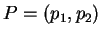 and
and
 on the
line and check that
on the
line and check that  is perpendicular to
  . Second method: The gradient of a function of two
variables at any point is perpendicular to the level curve
of the function through that point. (See the preceding
problem.)
. Second method: The gradient of a function of two
variables at any point is perpendicular to the level curve
of the function through that point. (See the preceding
problem.)
Problem
EE-6. If the point-normal equation mentioned in
Observation 5 of §3 is rewritten as
 , what is
  in terms of
N
in terms of
N and
and  ?
?
Problem
EE-7. Explain Observation 6 of §3 by using the
point-normal form. (For given
x, choose
to be at the foot of the perpendicular from
x.)
Problem
EE-8. The relational and parametric representations of a
line can each be interpreted in terms of affine functions
between spaces. The relational form really expresses the
line as the set of points where a certain affine
transformation
 R
R R
R has value 0 (as
mentioned in Observation 6 of §3). The parametric
form really expresses the line as the image (set of all
values) of an affine transformation
P: R
has value 0 (as
mentioned in Observation 6 of §3). The parametric
form really expresses the line as the image (set of all
values) of an affine transformation
P: R R
R . In each case, find the extended matrix of the
affine transformation involved.
. In each case, find the extended matrix of the
affine transformation involved.
Problem
EE-9. Suppose you want to rotate a line  counterclockwise about the origin. (a) If the line is
given in relational form, how can you describe the new
coefficients
counterclockwise about the origin. (a) If the line is
given in relational form, how can you describe the new
coefficients
 in terms of the old
  ? (b) If the line is given parametrically, how can you
describe the new and
v in terms of the
old and
v? (Leave the answers in terms
of products of matrices and vectors, without multiplying
out.) (c) If the line is given in functional form
? (b) If the line is given parametrically, how can you
describe the new and
v in terms of the
old and
v? (Leave the answers in terms
of products of matrices and vectors, without multiplying
out.) (c) If the line is given in functional form
 , express the functional form of the rotated line
in terms of
, express the functional form of the rotated line
in terms of  and
and  .
.
Problem
EE-10. Given two points  ,
,  , suppose we
started from the equation
, suppose we
started from the equation
 x
x . In
§4 it is explained how we could be sure the equation
has the form
. (a) In this equation,
how could we be sure that not both
. In
§4 it is explained how we could be sure the equation
has the form
. (a) In this equation,
how could we be sure that not both  and are
zero, so that it does represent some line
and are
zero, so that it does represent some line  ? (An
equation
? (An
equation
 would represent the whole
plane; an equation
would represent the whole
plane; an equation
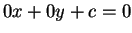 with
with  would represent the empty set.) (b) From the definition of
x
would represent the empty set.) (b) From the definition of
x , why is it obvious that both
and are on ?
, why is it obvious that both
and are on ?
Problem
EE-11. Show that the circle in
R through
three noncollinear points
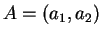 ,
,
 , and
, and
 is given
by
is given
by
![$ \det \left[\begin{array}{cccc} a _ 1 ^ 2 + a _ 2 ^ 2& a _
1& a _ 2& 1\\ b _ 1...
... + c _ 2 ^ 2& c _ 1& c _ 2&
1\\ x ^ 2 + y ^ 2& x& y& 1 \end{array}\right] = 0 $](img173.gif) .
.
Use these three steps: (a) Show that all three points
satisfy the equation. (b) By expanding the determinant in
a suitable way, show that the equation has the form
 , where
  . (c)
Explain why the graph of any equation of this form is a
circle or a single point or the empty set. (By (a), though,
the graph is not a single point or empty, so it's a circle.)
. (c)
Explain why the graph of any equation of this form is a
circle or a single point or the empty set. (By (a), though,
the graph is not a single point or empty, so it's a circle.)
Problem
EE-12. (a) (A high-school problem) Inscribe a triangle
in a semicircle of radius 1 so that one side of the triangle
is the diameter of the circle. What choice of the third
vertex of the triangle minimizes the area outside the
triangle? (b) (The relevance for us) Given a fixed base
 for a triangle and specified area
  , describe the set of all points for which the
triangle
, describe the set of all points for which the
triangle  has area , and say what this
answer has to do with
has area , and say what this
answer has to do with
 .
.
Problem
EE-13. (a) If you are looking at two points and
from a point and
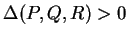 , is
to the right or to the left of , as seen from
? (b) In
R, is to the right or
to the left of as seen from , where
, is
to the right or to the left of , as seen from
? (b) In
R, is to the right or
to the left of as seen from , where  ,
,  ,
,  ?
?
Problem
EE-14. Show that if  are three points in
R, then
equals the third
component of the cross product in
R
are three points in
R, then
equals the third
component of the cross product in
R of
of  and
and  . (Use properties of determinants.)
Problem
EE-15. For points in
R, suppose we write
 x
x 
 . The
corresponding normal vector to the plane through , , and is
. The
corresponding normal vector to the plane through , , and is  . To see if this normal
vector is slanted up (so that the ``positive half-space'' is
the half-space above the plane rather than below), we need
to check that
. To see if this normal
vector is slanted up (so that the ``positive half-space'' is
the half-space above the plane rather than below), we need
to check that  . The problem: Show that
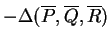 ,
where
,
where
 ,
,
 ,
,
 are orthographic projections on the
  -plane.
(Method: Expansion by cofactors.)
-plane.
(Method: Expansion by cofactors.)
Problem
EE-16. Show that it is not possible to have exactly
three of the four numbers
 ,
,
 ,
,
 ,
,
 be
zero.
be
zero.
Problem
EE-17. (a) Consider the three line segments
 ,
,
 ,
,
 ,
where
,
where  ,
,  ,
,  ,
,  ,
,  ,
,  . Find
explicitly the corresponding affine functions from the
two-point form. (Give coefficients numerically.) (b)
Using (a) determine which pairs among these line segments
cross. (There are three possible pairs to consider.) (c)
Find the points at which the pairs you listed in (b) cross.
. Find
explicitly the corresponding affine functions from the
two-point form. (Give coefficients numerically.) (b)
Using (a) determine which pairs among these line segments
cross. (There are three possible pairs to consider.) (c)
Find the points at which the pairs you listed in (b) cross.
Problem
EE-18. In Case 2 of §5, list as many different
ways as possible for how the four numbers
,
,
,
could be negative, zero, or positive. Make a sketch to
illustrate each way. To eliminate some cases that are
similar to others, assume that
 , that
, and that not all four numbers are zero.
, that
, that
, and that not all four numbers are zero.
Problem
EE-19. Explain explicitly step-by-step how a computer
could determine whether the line segments
and
intersect, where
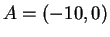 ,
,
 ,
,
 ,
,
 .
.
Problem
EE-20. Is the point  inside the
non-convex polygon with vertices
inside the
non-convex polygon with vertices
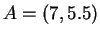 ,
,  ,
,  ,
,
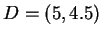 ,
,  ,
,  (in order)?
Do this problem twice, by using Method #1 and then Method
#2 of §8. (For this particular polygon and choice
of , all angles should come out to be multiples of
 .)
.)
Problem
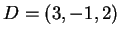
EE-21. If line segments
 in
R are viewed from above at infinity , does
one appear to pass above the other, and if so, which, where
in
R are viewed from above at infinity , does
one appear to pass above the other, and if so, which, where
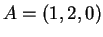 ,
,
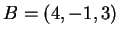 ,
,
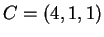 ,
and
,
and
 ? Use a method suitable for a
computer.
? Use a method suitable for a
computer.
(Suggested: First determine whether the projections of
on the -plane cross.
If they do, then use the same  for the original
segments to find the two points that appear to the viewer to
be on top of one another. See which of the two points has
the greater
for the original
segments to find the two points that appear to the viewer to
be on top of one another. See which of the two points has
the greater  -value.)
Problem
EE-22. Consider any line in
R.
Designate the half-plane on one side as ``positive'' and the
other half-plane as ``negative''. The corresponding signed
distance function  is simply the perpendicular
distance of from if is in
the positive half-plane, or minus that distance if is in the negative half-plane. The signed distance
function ought to be an affine function defining .
Is it? (To see, start with any affine function defining and scale it, using Observation 6 of §3.)
is simply the perpendicular
distance of from if is in
the positive half-plane, or minus that distance if is in the negative half-plane. The signed distance
function ought to be an affine function defining .
Is it? (To see, start with any affine function defining and scale it, using Observation 6 of §3.)
Problem
EE-23. Proposition. The distance of the point from the line with equation
is the
absolute value of
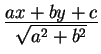 .
.
Prove this proposition by using Observation 6 of §3. (The fraction is an affine function. What is the length of its normal?)
Problem
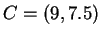
EE-24. In
R, consider the triangle ,
with  ,
,  ,
,
 .
Find the barycentric coordinates of these points:
itself,
.
Find the barycentric coordinates of these points:
itself,  ,
,  ,
,
 .
.
Problem
EE-25. Sketch a triangle in the plane. (a)
Indicate on it the point with barycentric coordinates
 and the point
with
and the point
with
 .
(b) Indicate all points with
.
(b) Indicate all points with
 . (c) Indicate all points with
 and all
points with
and all
points with
 .
.
Problem
EE-26. Show that barycentric coordinates in a triangle
are invariant under translation, and in fact are invariant
under any affine transformation. (Method: Starting from a
relation
 with
with
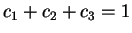 , apply an affine transformation
 x
x x
x b and see if the same relation holds
between the image points
b and see if the same relation holds
between the image points
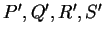 , where
  and so on.)
Problem
EE-27. Prove Proposition 3 of §9. (Method:
Given  , write
  as a linear combination of
the linearly independent vectors
as a linear combination of
the linearly independent vectors  and
and  .)
.)
Problem
EE-28. Prove Proposition 5 of §9. (Take the
vector equation
 and
write it as two equations, one for each coordinate. Then
with the equation
, you have
three equations in three unknowns. Use Cramer's rule to
solve them, and show that you get the result wanted. Use
the fact that
and
write it as two equations, one for each coordinate. Then
with the equation
, you have
three equations in three unknowns. Use Cramer's rule to
solve them, and show that you get the result wanted. Use
the fact that
 .)
.)
Problem
EE-29. Take a triangle such that
. For each point in the plane, each of
the three barycentric coordinates could be  ,
,  , or
, or  , making
 conceivable outcomes. Break the plane into regions (some of
which could be single points or pieces of lines) based on
outcomes that actually occur. How many regions are there
(twenty-seven, or some smaller number)? Make a sketch with
labels for each of your regions.
conceivable outcomes. Break the plane into regions (some of
which could be single points or pieces of lines) based on
outcomes that actually occur. How many regions are there
(twenty-seven, or some smaller number)? Make a sketch with
labels for each of your regions.
Problem
EE-30. Invent barycentric coordinates for a tetrahedron
in
R and state facts similar to those in §9.
Problem
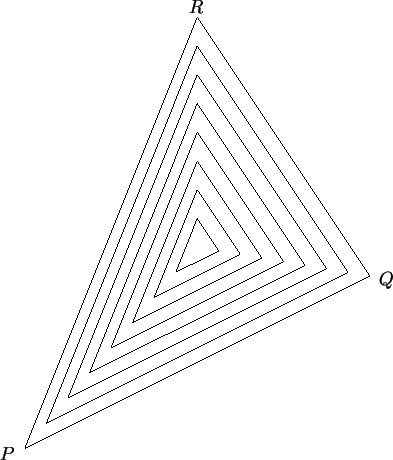
EE-31. Describe in detail an algorithm to draw the pattern
shown in Figure . Here  ,
,  ,
,  .
.
Problem
EE-32. Describe in detail an algorithm to draw the pattern
shown in Figure . Assume that you have a
plotting package that will draw a circle if you tell it the
center and the radius.
Problem
EE-33. Is the point  inside the triangle with vertices
 ,
,  ,
,  ? Use a method suitable for a computer.