


Quiz 4 in discussion section, Tuesday, October 23: The same kind of problem as last week, except use the opposite method from the one you used for Quiz 3. If you did the problem directly, do it by an isomorphism, and vice versa.
Midterm #1 will be Friday, October 26, in a different room: Haines A18
Reading. Read §3.1.
Assignment due in lecture Wednesday, October 24 (shorter because of the midterm)
| where | Do but don't hand in | Hand in |
| p. 66 | Ex. 6 | Ex. 7 |
| p. 73 | Ex.'s 1, 2, 3 | |
| J | J-1, J-4 | J-2, J-3, J-5, J-6, J-7, J-8 |
Problem J-1. On Handout H, solve the problems from §2, §5, and §7.
Problem J-2. On Handout H, solve the problems from §8 and §9.
Problem
J-3. (a) Show that a nonzero matrix  has rank 1 if and only if
it is the matrix product of a column vector times a row vector.
has rank 1 if and only if
it is the matrix product of a column vector times a row vector.
(b) If is a matrix each of whose rows is a finite
arithmetic progression, show that has rank at most 2.
(Suggestion: Use column relations as discussed in lecture.)
Discussion.
In (a), ``nonzero matrix'' means ``not the zero matrix'', so
it's OK if some entries are 0, but not all. In contrast to
this problem, notice that for a row vector times a column vector,
the product doesn't make sense unless they are have the same
length, and then the product is the same as their dot product.
For a column vector times a row vector they don't have to be
the same length and the product is a larger matrix. ``If and
only if'' is
 ; prove each direction separately.
In (b), the finite arithmetic progresson with  terms,
initial term
terms,
initial term  , and difference
  means the finite
sequence
means the finite
sequence
 .
.
To gain an understanding of each of (a) and (b), on your own try examples with numbers first.
Problem J-4. (a) Number the fingers on your right hand 1 through 5 with your thumb as 1. Suppose you count back and forth starting 1, 2, 3, 4, 5, 4, 3, 2, 1, 2, ...Which finger gets the millionth count in this list?
(b) What is the last digit of
 (base 10)?
(c) What do (a) and (b) have to do with congruences?
Problem
J-5. (a) In a previous problem you have found that for  = GF(2),
 has three 1-dimensional subspaces. If
  is any
two-dimensional vector space over GF(2), how many 1-dimensional
subspaces does it have, and why?
is any
two-dimensional vector space over GF(2), how many 1-dimensional
subspaces does it have, and why?
(b) Similarly, in a previous problem you have found that for
 ,
,  has seven one-dimensional subspaces and
seven two-dimensional subspaces.
has seven one-dimensional subspaces and
seven two-dimensional subspaces.
Using Theorem 6, p. 46, relating the dimensions of the sum and intersection of two subspaces to the dimensions of the subspaces, show that any two 2-dimensional subspaces intersect in a 1-dimensional subspace.
(c) Also, for two given 1-dimensional subspaces, how many 2-dimensional subspaces contain both? (Reason directly or by the same theorem as in (b).)
(d) Putting together (a), (b), (c), solve Problem G-9 again by
using the 1-dimensional subspaces of for plants and the
2-dimensional subspaces to determine blocks.
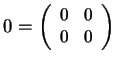
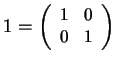
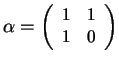
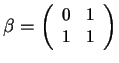
Problem J-6. This problem shows one way to construct GF(4) concretely. Consider the following four matrices over GF(2):
 ,
,
 ,
,
 ,
,
 .
.
Here the symbols  are used for two different things
(elements of GF(2) and matrices), but it should always
be clear which is meant.
are used for two different things
(elements of GF(2) and matrices), but it should always
be clear which is meant.
Let
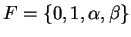 .
.
(a) is contained in the set of all
 matrices
over GF(2). Show that is closed under matrix addition,
negation, and multiplication, by making addition and multiplication
tables using
matrices
over GF(2). Show that is closed under matrix addition,
negation, and multiplication, by making addition and multiplication
tables using
 for entries. (What about
negation? Does
for entries. (What about
negation? Does
 ?)
?)
(b) Show that is a field. (To save effort, you may quote
any laws you know about operations on matrices.)
(c) What is the characteristic of ?
(d) Is  a subfield of ? If so, is this subfield
isomorphic to
a subfield of ? If so, is this subfield
isomorphic to
 ?
?
Note.
 , so we can just write
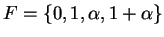 . In the end it is best to think
about this way and forget it came from matrices, just as
. In the end it is best to think
about this way and forget it came from matrices, just as
 can be made from matrices but we don't think of it that way.
Problem
J-7. A ``Latin square'' is an
 table whose entries
are different symbols each repeated times, arranged
so that no row or column has a repeated symbol. For example,
in Problem G-9, the card numbers made a Latin square, and
so did the suits.
table whose entries
are different symbols each repeated times, arranged
so that no row or column has a repeated symbol. For example,
in Problem G-9, the card numbers made a Latin square, and
so did the suits.
(a) Show that in any finite field the addition table makes a Latin square.
(b) Show that in any finite field the multiplication table for non-zero elements makes a Latin square.
As one example, you made addition and multiplication tables for
GF(4) in Problem ![[*]](/lib/latex2html-icons/crossref.gif) . As another example, GF(5) =
. As another example, GF(5) =
 has tables
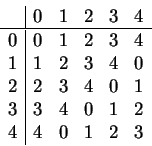 and
and
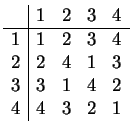
Method: In both parts, use field properties rather than trying
to describe the table precisely. You can refer to rows and
columns by field elements, e.g., ``row  '' where is
an arbitrary element of .
'' where is
an arbitrary element of .
Problem
J-8. Two Latin squares are said to be ``orthogonal'' if when one
is laid on top of the other all possible pairs occur. For example,
your solution to Problem G-8 showed that it's possible to have
two orthogonal
 Latin squares, one made from the
card numbers and the other made from the suits.
Latin squares, one made from the
card numbers and the other made from the suits.
(a) Show that if is a finite field with elements, you
can make  Latin squares, each
, so that any
two are orthogonal.
Latin squares, each
, so that any
two are orthogonal.
Method: Let
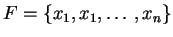 ; one of
these elements is 0 and another is 1, but that doesn't even matter.
For each nonzero
; one of
these elements is 0 and another is 1, but that doesn't even matter.
For each nonzero  , make a table
  by saying
that
by saying
that
 is
is
 for
for
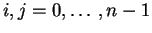 . Then show that these tables have the desired properties.
(b) Using = GF(4), show that you can do even better than
G-8: Show how to take four different decks of cards (say with
red, green, blue, and silver backs, just to identify them) and
make one
arrangement of sixteen cards using Ace,
2, 3, 4 so that in each row and column, no number, suit, or deck
is repeated, and also each of the sixteen possible pairs of
number and suit occurs, each of the sixteen possible pairs of
number and deck occurs, and each of the sixteen possible pairs
of suit and deck occurs.
Method: From (a), superimposing the three resulting Latin
squares you will get triples of field elements that need to be
turned into a card number, suit, and deck. For uniformity,
let's say for the first Latin square
become
respectively Ace, 2, 3, 4; for the second,
become Spades, Hearts, Diamonds, Clubs; and for the third they
become red, green, blue, silver.
Note. The problems on card arrangements and designs with blocks are part of the subject of combinatorics.