


For Problem V-16:
All of them are equivalence relations:
(v) is reflexive since  , which is even; symmetric
since
, which is even; symmetric
since  is even implies
  is even; transitive since
and
is even; transitive since
and  both even imply
 is
even.
is
even.
(vi) is reflexive since
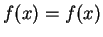 ; symmetric since
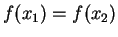 implies
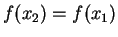 ; transitive since
if
; transitive since
if  has equal values at
  and
and  and
equal values at and
and
equal values at and  then has equal
values at and .
then has equal
values at and .
(vii) is reflexive since
 0
0 ; symmetric since
  implies
 ; transitive since and
  imply
imply
 .
.
(viii) is reflexive since  has the same row space as itself;
symmetric since if and
has the same row space as itself;
symmetric since if and  have the same row space then
and have the same row space; transitive since if and
have the same row space and and
have the same row space then
and have the same row space; transitive since if and
have the same row space and and  have the same row space
then and have the same row space.
have the same row space
then and have the same row space.
(ix) is reflexive since
 so
so  ;
symmetric since if
;
symmetric since if  using
using
 then
then  using
using
 ; transitive since
and
; transitive since
and  imply
imply
 and
and
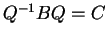 for some invertible
  and
and  , so that
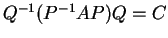 , which is the same as
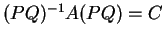 , so
, so
 .
.
(x) is all three since any assertion that two elements are related is true, and the three properties consist of such assertions.
(xi) is reflexive since any element is in the same block as itself;
symmetric since if  and
and  are in the same block then
and are in the same block; transitive since if and
are in the same block and and
are in the same block then
and are in the same block; transitive since if and
are in the same block and and  are in the same block then
and are in the same block.
are in the same block then
and are in the same block.
For Problem V-17:
The ``proof'' gives the impression that it is talking about all possible  ,
but what it actually says is that if is related to something is
true. So what the proof actually proves is that if is related to
then is related to itself. It doesn't say anything about
an that is related to no elements.
,
but what it actually says is that if is related to something is
true. So what the proof actually proves is that if is related to
then is related to itself. It doesn't say anything about
an that is related to no elements.
For a counterexample to the assertion, then, let
 and
say
and
say  when and are both integers. This
 is symmetric and transitive but not symmetric. For a simpler
counterexample, take any nonempty set
is symmetric and transitive but not symmetric. For a simpler
counterexample, take any nonempty set  and let be the
``empty relation''--no two elements are related.
and let be the
``empty relation''--no two elements are related.
For Problem V-18:
For (i): Let's rephrase the three properties of equivalence relations
using the definition of  : Reflexivity says that (1)
 ; symmetry says that (2)
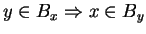 ; transitivity says that (3)
 and
and
 imply
imply
 .
.
Notice that we also have
(4) if
 then
then
 .
.
The reason: Suppose
. To show
 : If
then by
and (3) we have
. To show
: If
then by
and (3) we have
. To show
 notice that by (2) we can turn
around
to get
.
notice that by (2) we can turn
around
to get
.
Now to show the distinct blocks make a partition: By (1), each
is in its own block, so the union of all the blocks is all
of  . To show that if two blocks are distinct then they are
pairwise disjoint, let's do the contrapositive: If two blocks
have an element in common, i.e., if
. To show that if two blocks are distinct then they are
pairwise disjoint, let's do the contrapositive: If two blocks
have an element in common, i.e., if
 and
then
and
then
 . But that's true by
(4), since
. But that's true by
(4), since
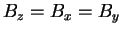 .
.
For (ii): We are asked to start with , make the
partition described in (i), and then show that it gives
back. In other words if the relation  is defined by
 when and are in the same block, then
 . We can do this in two parts: First, does
 ? Yes: If
, so that
and are in the same block, then since
that block must be , so
, which
by definition says . Next, does
? Yes: If
, so that
and are in the same block, then since
that block must be , so
, which
by definition says . Next, does
 ? Yes: If then by (4)
and by (1) both and are in this block.
? Yes: If then by (4)
and by (1) both and are in this block.
For Problem V-19:
Of (i)-(iv) only (iii) (equality) is an equivalence relation; it corresponds to (g) (singleton blocks).
All of (v)-(xi) are equivalence relations.
(v) corresponds to (e) in Q-2 (even/odd), which is the same as congruence blocks modulo 2.
(vi) corresponds to (h).
(vii) corresponds to (b)
(viii)-(xi) have no correspondence to examples in Q-2.
For Problem V-20:
Congruence modulo  is reflexive, since
  so
so
 . The relation is symmetric, since
  means
means
 for some
  , so
, so
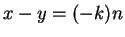 ,
giving
,
giving  . The relation is transitive since
and
. The relation is transitive since
and  say and
 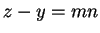 for some
  and then
 so
so
 . Therefore congruence modulo is an equivalence
relation.
. Therefore congruence modulo is an equivalence
relation.
Notice that Example (i) in Problem V-![[*]](/lib/latex2html-icons/crossref.gif) is congruence
modulo 2.
is congruence
modulo 2.
The blocks of a congruence relation are called ``congruence classes
modulo ''. Again, it would be better if people called these
``congruence blocks'' instead.