


For Problem E-1:
Method #1: If
 0, expanding and
then regrouping we get
0, expanding and
then regrouping we get
 0. Since
 are linearly independent, these coefficients must be
0, so
are linearly independent, these coefficients must be
0, so
 . Working backwards from
 we get
  ,
,  . Therefore
0 implies
. Therefore
0 implies
 , and so
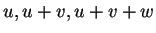 are linearly independent.
Method #2: The subspace  of
of  generated by
is isomorphic to
generated by
is isomorphic to  with corresponding to
 , since span it and are linearly
independent. Under this isomorphism,
correspond to
, since span it and are linearly
independent. Under this isomorphism,
correspond to
 . Making these the
rows of a matrix and row-reducing we get the identity matrix,
which has rank 3, so they must be linearly independent. Using
the isomorphism,
must be linearly independent.
. Making these the
rows of a matrix and row-reducing we get the identity matrix,
which has rank 3, so they must be linearly independent. Using
the isomorphism,
must be linearly independent.
For Problem E-2:
Using the augmented matrix and row reducing,
![$ \left[\begin{array}{rrrrr}1&0&1&0&0\ 0&0&1&1&0\ 1&1&0&1&0\ 0&1&1&0&1\end...
...&0&0\ 0&1&1&1&0\ 0&0&1&1&0\ 0&0&0&1&1\end{array}\right] \rightsquigarrow $](img212.gif)
![$ \left[\begin{array}{rrrrr}1&0&0&1&0\ 0&1&0&0&0\ 0&0&1&1&0\ 0&0&0&1&1\end...
...rray}{rrrrr}1&0&0&0&1\ 0&1&0&0&0\ 0&0&1&0&1\ 0&0&0&1&1\end{array}\right],$](img213.gif) from which we see there is the unique solution
from which we see there is the unique solution
 . This checks.
For Problem E-3:
![$ M = \left[\begin{array}{rrrrr} 1& 2& 1& 3& -2\ 1& 2& 2& 3& 0\ 1& 2& 3& 3& ...
...left[\begin{array}{rrrrr}1&2&0&3&-4\ 0&0&1&0&2\ 0&0&0&0&0\end{array}\right]$](img215.gif) .
.
The two nonzero rows of  are a basis for the row space.
For the null space, we write the general solution in variables,
say,
 , getting
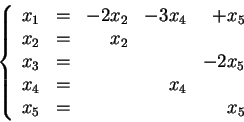
so
![$ \left[\begin{array}{c}x_1\ x_2\ x_3\ x_4\ x_5\end{array}\right] = x_2 ...
...ay}\right] + x_5 \left[\begin{array}{r}1\ 0\ -2\ 0\ 1\end{array}\right]$](img218.gif) . These three column vectors
are then the basis.
. These three column vectors
are then the basis.
For the column space, we look at and see that the pivot
columns are columns 1 and 3, so a basis for the column space is
columns 1 and 3 of  . (Alternatively, we could transpose ,
row reduce, and take the resulting nonzero rows.)
. (Alternatively, we could transpose ,
row reduce, and take the resulting nonzero rows.)
For Problem E-4:
(a) one-to-one and onto; (b) neither; (c) onto; (d) neither; (e) one-to-one.
For Problem E-5:
If
 in
in  , is
, is
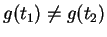 ? Since
 is onto we know
 ,
,
 , for
some
, for
some
 ; we must have
 or else we
would have
or else we
would have
 .
.
 are defined to
be
are defined to
be  , so the answer is yes. Therefore
  is one-to-one.
If  is there some
  with
with  ? Yes,
 works. So is onto.
For Problem E-6:
First, some notation: If we have a function like
 given
by
given
by
 and we want to describe it without naming it,
we can just write
and we want to describe it without naming it,
we can just write
 , which we say as ``
 maps
to
maps
to  ''. The different-looking arrow is a reminder that
we're talking about elements rather than whole spaces. But sometimes
it's handy to use this kind of notation with the name of a function;
for example, instead of ``Let '' we can say ``Let
''. The different-looking arrow is a reminder that
we're talking about elements rather than whole spaces. But sometimes
it's handy to use this kind of notation with the name of a function;
for example, instead of ``Let '' we can say ``Let
 '', read as ``
 maps to
  under '' or
``via ''.
under '' or
``via ''.
In this notation, if
 is a one-to-one correspondence
then
is the same as
is a one-to-one correspondence
then
is the same as
 .
.
The same notation can be used to to express the idea that a
linear transformation
 preserves addition of vectors:
Instead of
 we can say
``If
 and
and
 then
then
 .''
.''
To say that preserves multiplication by scalars, we can say
``If
 then
then
 ,
for any
,
for any  ''.
''.
Now to do the problem: To check that  preserves addition,
we must show that for any
preserves addition,
we must show that for any
 if
if
 and
and
 then
then
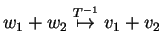 . But this is exactly
the same as saying that if
and
then
, which is true since
preserves addition. Therefore preserves addition.
. But this is exactly
the same as saying that if
and
then
, which is true since
preserves addition. Therefore preserves addition.
Similarly, to check multiplication by scalars, if
 then we want
 .
But this is the same as
, which is true
since preserves multiplication by scalars.
.
But this is the same as
, which is true
since preserves multiplication by scalars.
Therefore is an isomorphism.
For Problem E-7:
In (b), with the basis  for
Pols
for
Pols there
is an isomorphism
there
is an isomorphism
 Pols taking
to . Under this isomorphism, part (b) becomes part (a),
so the span is the whole space.
Pols taking
to . Under this isomorphism, part (b) becomes part (a),
so the span is the whole space.
(c) In (c), using the basis  for
Pols,
the resulting isomorphism with
for
Pols,
the resulting isomorphism with
 turns part (c) into part (a),
so the span is the whole space.
turns part (c) into part (a),
so the span is the whole space.
For Problem E-8:
For (a):
(ii) says the pivot columns of  are columns 1, 3, and 5.
(iii) expresses the other columns as linear combinations of the
pivot columns. Therefore columns 2, 4, and 6 are
![$ \left[\begin{array}{r}3\ 0\ 0\end{array}\right]$](img260.gif) ,
,
![$ \left[\begin{array}{r}2\ 5\ 0\end{array}\right]$](img261.gif) , and
, and
![$ \left[\begin{array}{r}-1\ 7\ -4\end{array}\right]$](img262.gif) .
.
Putting these together says that the mystery matrix is
![$ M = \left[\begin{array}{rrrrrr}1&3&0&2&0&-1\ 0&0&1&5&0&7\ 0&0&0&0&1&-4\end{array}\right]$](img263.gif) .
.
For (b): Knowing the linear relations means we know which columns are linear combinations of preceding columns, and what the coefficients are. So just as for the mystery matrix, if we are given any matrix in row-reduced echelon form, the pivot columns are those which are not the in the span of the preceding columns; these columns look like some columns of the identity matrix, in order. Each remaining column is a linear combination of the preceding pivot columns, and the coefficients tell its entries.
For (c): Suppose is row-reduced by two people to matrices
 and
and  in row-reduced echelon form. Both
and have the same linear relations between columns as
does and so have the same linear relations between columns as
each other. But by (b) we know these linear relations uniquely
determine the entries of and , so that
in row-reduced echelon form. Both
and have the same linear relations between columns as
does and so have the same linear relations between columns as
each other. But by (b) we know these linear relations uniquely
determine the entries of and , so that  .
Therefore the row-reduced echelon form is unique.
.
Therefore the row-reduced echelon form is unique.