


For Problem D-1:
(a) If  , then since scalars are in a field we can
multiply the equation
, then since scalars are in a field we can
multiply the equation
 0 on both sides by
  on the left,
obtaining
on the left,
obtaining
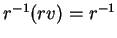 0. By laws (f) and (e)
and the lhs (left-hand-side) is
0. By laws (f) and (e)
and the lhs (left-hand-side) is
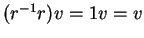 ,
while the rhs is
0 by (i). Therefore we get
,
while the rhs is
0 by (i). Therefore we get
 0.
In other words, if
0.
In other words, if  isn't the zero scalar then
  is the
zero vector, so one of them is zero, as stated.
is the
zero vector, so one of them is zero, as stated.
(b) The outline is
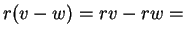 0
0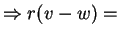 0
0 0
0 is canceled
using part (a) (not law (a)).
is canceled
using part (a) (not law (a)).
For a full proof we need to
justify our use of familiar algebra for binary minus, since
binary minus and laws for it are not in our definition of a
vector space. Instead, binary minus is defined outside the definition of
a vector space by
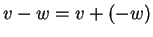 . We do have laws such as
 because by laws (k) and (f) we have
 .
.
The first equation
in the outline above comes from
 . The last implication in the outline
comes from adding
. The last implication in the outline
comes from adding  to both sides:
 0
0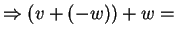 0
0 ,
where various defining laws have been used.
,
where various defining laws have been used.
(c) In outline,
 0
0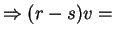 0
0
Notice that in the original handout there was a misprint in law (h),
which should say
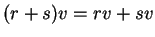 .
.
For Problem D-2:
We can define  to mean
  . Then
 by this definition and by (e), which equals
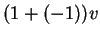 by (h),
which equals
by (h),
which equals  by the fact that
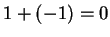 in a field,
which equals
0 by (j). We have shown
in a field,
which equals
0 by (j). We have shown
 0,
which is (d).
0,
which is (d).