


No quiz this week. Homework due Friday, November 30:
These include a couple of topics that will be discussed
10-M and 10-W (Jordan canonical form and determinants.)
| where | Do but don't hand in | Hand in |
| DD | DD-11 | DD-10 |
| EE | EE-1, EE-2, EE-5, EE-6, EE-8, EE-10 | EE-3, EE-4, EE-7, |
| EE-11, EE-12, EE-13, EE-14, EE-15, EE-16 | EE-9, EE-17(a)-(c) | |
| FF | FF-1, FF-2 |
Problem EE-1. For the theorem that eigenvectors for distinct eigenvalues are linearly independent, in class we used an informal induction. Write out a proof using a formal induction. Method:
(This will be some statement depending on an integer parameter.
In the present problem, we are discussing  eigenvectors of
an
eigenvectors of
an
 matrix, and it's that is the parameter.
The proof doesn't mention
matrix, and it's that is the parameter.
The proof doesn't mention  .)
.)
 or
or  ). Often this is trivial.
, assuming
that it is true for the case  . (This assumption is the
``inductive hypothesis''.)
. (This assumption is the
``inductive hypothesis''.)
by mathematical induction.''
Note. Usually a proof by induction involves some statement  that is to be proved infinitely many values of . In the present
problem, though, goes up only to , or to however many
distinct eigenvalues there are if there are fewer than distinct
values.
For more on induction, see the link on our course home page.
that is to be proved infinitely many values of . In the present
problem, though, goes up only to , or to however many
distinct eigenvalues there are if there are fewer than distinct
values.
For more on induction, see the link on our course home page.
Problem EE-2. What is wrong with the following ``proof'' that all cows are the same color?
``Statement: Any cows are the same color, for
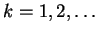 Proof by induction: The case is trivially true. Assume
the case holds, and consider cows. Line them up.
By the inductive hypothesis, the first are the same
color and so are the last . Since the first and
the last overlap in the middle, all the cows must be the
same color.''
Proof by induction: The case is trivially true. Assume
the case holds, and consider cows. Line them up.
By the inductive hypothesis, the first are the same
color and so are the last . Since the first and
the last overlap in the middle, all the cows must be the
same color.''
Problem
EE-3. (a) Show that if a matrix  commutes
with a diagonal matrix
commutes
with a diagonal matrix  whose diagonal entries are
distinct, then is also diagonal.
whose diagonal entries are
distinct, then is also diagonal.
(b) Show that if a matrix  commutes with a diagonalizable
matrix
commutes with a diagonalizable
matrix  that has no repeated eigenvalues (i.e.,whose
eigenvalues are distinct), then is also diagonalizable.
In fact, show that and are simultaneously
diagonalizable (meaning that the same
that has no repeated eigenvalues (i.e.,whose
eigenvalues are distinct), then is also diagonalizable.
In fact, show that and are simultaneously
diagonalizable (meaning that the same  can be used for
both). (Method: Remember, the map
can be used for
both). (Method: Remember, the map
 preserves
multiplication.)
preserves
multiplication.)
Problem
EE-4. In finding a square root for
![$ A = \left[\begin{array}{rr}5&4\\ 4&5\end{array}\right]$](img15.gif) we
discussed how to get four answers. Are there any other
answers--at least, are there any other answers that are
diagonalizable?
we
discussed how to get four answers. Are there any other
answers--at least, are there any other answers that are
diagonalizable?
(Method: This time we must show that if  then is
one of four possibilities. The proof will sound like the original
construction, but the reasoning is a little different:
Start by diagonalizing using some . Leave
unchanged throughout the rest of the problem. Let
then is
one of four possibilities. The proof will sound like the original
construction, but the reasoning is a little different:
Start by diagonalizing using some . Leave
unchanged throughout the rest of the problem. Let
 . Then
  . (Why?) Use Problem
EE-
. (Why?) Use Problem
EE-![[*]](/lib/latex2html-icons/crossref.gif) to show that
to show that  is diagonal, and then
discuss the possibilities for . If you can pin down,
then is uniquely determined by since
is diagonal, and then
discuss the possibilities for . If you can pin down,
then is uniquely determined by since
 .)
.)
Problem EE-5. Make up an example as though you were tutoring a Math 115A student, as follows:
(a) Invent a
 matrix with nonzero integer
entries so that can be diagonalized using for which
both and
matrix with nonzero integer
entries so that can be diagonalized using for which
both and  have only integer entries.
(b) Make up a simultaneous DE problem using and solve it.
Problem
EE-6. Diagonalize the matrix
 over
over
 .
.
Problem
EE-7. As in Problem EE-, to diagonalize a
matrix it may be necessary to work in a larger field.
Show that this is the case for the matrix
![$ A = \left[\begin{array}{rr}1&1\\ 1&0\end{array}\right]$](img25.gif) over GF(2). Specifically, show that is not diagonalizable
over GF(2), but is diagonalizable over a larger field.
over GF(2). Specifically, show that is not diagonalizable
over GF(2), but is diagonalizable over a larger field.
Problem EE-8. Using Jordan canonical form, explain why it's obvious that a matrix with distinct eigenvalues is diagonalizable.
Problem
EE-9. A matrix is a projection if  . For
example,
. For
example,
![$ A = \left[\begin{array}{rr}1&0\\ 0&0\end{array}\right]$](img27.gif) is a projection, as are any
size identity matrix and any size square zero matrix.
Show that any projection is diagonalizable. (Method: Use
Jordan canonical form.)
is a projection, as are any
size identity matrix and any size square zero matrix.
Show that any projection is diagonalizable. (Method: Use
Jordan canonical form.)
Problem
EE-10. Invent a real
matrix such that
 . (Method: Use Cayley's theorem.)
Problem
EE-11. Using the fact that the volume of a sphere of unit radius is
 , find a formula for the volume of an ellipsoid with
semimajor axes
, find a formula for the volume of an ellipsoid with
semimajor axes  .
.
Problem
EE-12. How is the determinant of a permutation matrix related to
the sign of the permutation (which means 1 for even,  for odd)?
Explain.
for odd)?
Explain.
Problem
EE-13. For finding the determinant of a
 matrix,
compare the number of multiplications involved in using the
permutation definition of a determinant, versus the number involved
in finding the determinant using elementary row operations.
(Approximate numbers are OK.)
matrix,
compare the number of multiplications involved in using the
permutation definition of a determinant, versus the number involved
in finding the determinant using elementary row operations.
(Approximate numbers are OK.)
Problem
EE-14. Suppose that there are three containers, containing
respectively a red marble, a blue marble, and a green marble.
The tops of the containers are labeled  . However,
all the labels are wrong! How many containers do you have to
look inside before you know the correct contents of all three
containers?
. However,
all the labels are wrong! How many containers do you have to
look inside before you know the correct contents of all three
containers?
Problem
EE-15. For  , the set of permutations on four symbols, what
kinds of cycle decompositions are possible? Which are even and
which are odd? (It is not necessary to list all 24 permutations,
just the possible forms of cycles, e.g.,
, the set of permutations on four symbols, what
kinds of cycle decompositions are possible? Which are even and
which are odd? (It is not necessary to list all 24 permutations,
just the possible forms of cycles, e.g.,
 ,
meaning any 3-cycle.)
,
meaning any 3-cycle.)
Problem EE-16. What is the change-of-basis matrix in each of the following cases?
(a)
 . The old basis is the standard basis;
the new basis consists of
. The old basis is the standard basis;
the new basis consists of
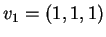 ,
,
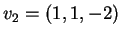 ,
,
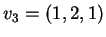 .
.
(b) Same as (a) with old and new switched.
(c)  is the subspace of
 that is the solution
space of
that is the solution
space of 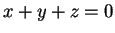 . The old basis consists of
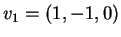 ,
,
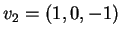 ; the new basis consists of
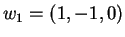 ,
,
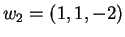 .
.
(d)
 and is a diagonalizable
real matrix. The old basis is the standard basis; the new
basis consists of linearly independent eigenvalues
and is a diagonalizable
real matrix. The old basis is the standard basis; the new
basis consists of linearly independent eigenvalues
 .
.
(e)
 Pols
Pols . The old basis is
  ; the new
basis is
; the new
basis is
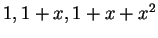 .
.
Problem
EE-17. A van der Monde matrix is a square matrix of the form
![$ \left[\begin{array}{ccccc}
1&x _ 1& x _ 1 ^ 2&{\dots }&x _ 1 ^ {n-1}\\
{\dot...
...dots }&{\dots }\\
1&x _ n& x _ n ^ 2&{\dots }&x _ n ^ {n-1}\end{array}\right]$](img53.gif) ,
where
,
where
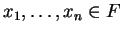 for a field
  .
.
A van der Monde determinant is the determinant of a van der Monde matrix. It has a nice value:
Theorem. The van der Monde determinant
 , or better,
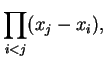
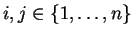 with
with  . For
example, for
. For
example, for  we get
 .
.
(a) What is the value of the
 van der Monde
determinant with
van der Monde
determinant with
 ,
,
 ,
,
 ?
?
(b) If
 are distinct then the van der Monde
matrix is invertible. Explain why. (Easy.)
are distinct then the van der Monde
matrix is invertible. Explain why. (Easy.)
(c) Explain why there must be a unique parabola
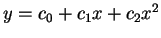 through the three data points
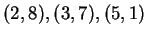 .
.
(Method: Set this up as equations with
 as
unknowns. You are not asked to solve the equations. Interestingly,
even though we are talking about a parabola, the equations are linear,
because the coefficients of a quadratic appear linearly!)
as
unknowns. You are not asked to solve the equations. Interestingly,
even though we are talking about a parabola, the equations are linear,
because the coefficients of a quadratic appear linearly!)
(d) Use the Theorem to re-prove the theorem that eigenvectors for distinct eigenvalues are linearly independent, without using induction.
(Method: Take the equation
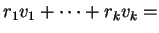 0,
in which you are hoping to show the coefficients are all 0.
Apply
0,
in which you are hoping to show the coefficients are all 0.
Apply  repeatedly to get
  more equations, of which the
last is
more equations, of which the
last is
 0. As you know, the first equation can be
rewritten as
r
0. As you know, the first equation can be
rewritten as
r 0, where is an
 matrix with
columns
matrix with
columns
 and
r
and
r![$ = \left[\begin{array}{c}r _ 1\\ \dots \\ r _ k\end{array}\right]$](img77.gif) .
Rewrite the other equations the same way, using but fancier things
in place of
r. Put
r and the fancier things as columns of a
matrix
.
Rewrite the other equations the same way, using but fancier things
in place of
r. Put
r and the fancier things as columns of a
matrix  , so
, so
 (the zero matrix). Then factor
as a diagonal matrix with diagonal entries
(the zero matrix). Then factor
as a diagonal matrix with diagonal entries
 times a van der Monde matrix. Since the van der Monde matrix is invertible
you can cancel it. Then what?)
times a van der Monde matrix. Since the van der Monde matrix is invertible
you can cancel it. Then what?)