


Quiz 9 in discussion section Tuesday, November 27:
For a linear transformation
 between vectors spaces
and a subspace
between vectors spaces
and a subspace  of
of  , (a) be able to define what
 means, and (b) be able to prove that
is a subspace of
means, and (b) be able to prove that
is a subspace of  . (See Problem O-3 and its solution.)
Assignment due Friday, November 30.
| where | Do but don't hand in | Hand in |
| U | 7 | |
| CC | CC-1, CC-6, CC-7, CC-8, CC-9 | CC-2, CC-3, CC-4, CC-5, CC-10 |
| DD | DD-1, DD-3, DD-5, DD-7 | DD-2, DD-4, DD-6, DD-8, DD-9 |
Problem
CC-1. For the linear transformation
 R
R R
R with
with
![$ A = \left[\begin{array}{rr}3&-1\\ -3&1\end{array}\right]$](img9.gif) , sketch (a) the range, (b) the null space, and
(c) the inverse image of
, sketch (a) the range, (b) the null space, and
(c) the inverse image of
![$ \left[\begin{array}{r}2\\ -2\end{array}\right]$](img10.gif) [the set of vectors in the
domain that go to this vector]. Use two sets of axes. Do a
careful job, indicating the scale by ``tick marks'' on the axes.
Label your answers.
[the set of vectors in the
domain that go to this vector]. Use two sets of axes. Do a
careful job, indicating the scale by ``tick marks'' on the axes.
Label your answers.
Problem
CC-2. Let be the solution space of the DE  . Let
. Let
 be the basis consisting of
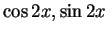 . If
. If
 is the differentiation operator, find the matrix of
  relative to this basis.
Problem
CC-3. (a) Diagonalize the matrix
![$ A = \left[\begin{array}{rr}2&1\\ 2&3\end{array}\right]$](img16.gif) . Be sure to
give
. Be sure to
give  and
and  , but you don't need to find
  .
.
(b) Diagonalize  . (Again, give .)
Problem
CC-4. (a) Diagonalize
![$ A = \left[\begin{array}{rr}2&3\\ 6&5\end{array}\right]$](img21.gif) , showing the
matrices involved, with explicit entries, including finding a matrix
inverse where needed. Show that your answer checks, by multiplying
out.
, showing the
matrices involved, with explicit entries, including finding a matrix
inverse where needed. Show that your answer checks, by multiplying
out.
(b) Find a matrix with  .
.
(Method: Diagonalize  using an appropriate , take a
cube root, and ``undiagonalize'' by doing a similarity back using
in place of .)
using an appropriate , take a
cube root, and ``undiagonalize'' by doing a similarity back using
in place of .)
Problem
CC-5. Show that for an
 matrix
and
matrix
and
 matrix over the same field,
trace
matrix over the same field,
trace trace
trace .
.
Problem
CC-6. (a) Show that square matrices  of the same size, if at
least one of and is invertible (i.e., nonsingular) then
of the same size, if at
least one of and is invertible (i.e., nonsingular) then
 and
and  are similar. (Method: Easy matrix manipulation.)
(b) Looking through past homework, find an example to show
that (a) might not hold if neither of and is invertible.
(Method: What if  ?)
?)
Problem CC-7. Invent a specific numeric example of each of the following, giving a brief reason in each case:
(a) A
 matrix with eigenvalues whose sum is 1 and
whose product is
matrix with eigenvalues whose sum is 1 and
whose product is  .
.
(b) A
diagonal matrix that is a rotation but is not the
identity matrix.
(c) A matrix such that
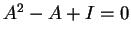 . (Method: Just
find a
matrix with characteristic polynomial
. (Method: Just
find a
matrix with characteristic polynomial
 . Magically, any matrix acts like
a root of its own characteristic polynomial. Check your answer.)
. Magically, any matrix acts like
a root of its own characteristic polynomial. Check your answer.)
(d) A matrix and eigenvalue  so that the eigenspace
 has dimension 2.
Problem
CC-8. By ``permutation'' we will always mean a permutation on a
finite number of symbols. Recall that a transposition means a
2-cycle such as
 .
.
(a) Show that the n-cycle
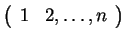 is a product
of transpositions. In other words, you can achieve an
is a product
of transpositions. In other words, you can achieve an  -cycle
by switching two symbols at a time, several times. (Advice:
Try this for
-cycle
by switching two symbols at a time, several times. (Advice:
Try this for  , then
  , etc. until you see a
general method.)
, etc. until you see a
general method.)
(b) Show that every permutation is a product of transpositions. (Quote the fact that every permutation is a product of ``disjoint'' cycles and use (a).)
(c) A permutation  is said to be even if is
the product of an even number of transpositions, or odd if
is the product of an odd number of transpositions.
is said to be even if is
the product of an even number of transpositions, or odd if
is the product of an odd number of transpositions.
It is a fact that any permutation is either even or odd, but not both.
Looking at the multiplication table for  (p. AA
3), say which permutations are even, which are odd, and check
that a transposition times an even permutation is odd and vice
versa. (It may help to draw a horizontal line and vertical line
to split the table into four areas.)
(p. AA
3), say which permutations are even, which are odd, and check
that a transposition times an even permutation is odd and vice
versa. (It may help to draw a horizontal line and vertical line
to split the table into four areas.)
Problem
CC-9. (a) For functions
 ,
solve the system of differential equations (DE's)
,
solve the system of differential equations (DE's)
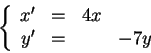 with
with  ,
,  .
.
(Method: Recall that for a single dependent variable the
solution of  is
is
 .)
.)
(b) Rewrite the problem in matrix form.
(Method:
x x with
x
x with
x . What is ?)
(c) Show that the solution can be expressed in matrix form using
a matrix power, as in Problem W-2, except that the initial values
become a vector on the right:
x x
x .
.
(d) Check the solution directly by taking the derivative of a
matrix power that is a function of  , inventing any
reasonable rules you need for derivatives of matrix functions
of .
, inventing any
reasonable rules you need for derivatives of matrix functions
of .
Problem
CC-10. Solve the system of DE's
x x where
![$ A =
\left[\begin{array}{rr}3&2\\ 2&3\end{array}\right]$](img57.gif) and
x
and
x![$ (0) = \left[\begin{array}{r}1\\ 2\end{array}\right]$](img58.gif) , two ways:
, two ways:
(a) by using similarity;
(b) by using a matrix power.
(Methods: For (a) diagonalize by
 and substitute
x
and substitute
x z, where
z
z, where
z![$ = \left[\begin{array}{r}z\\ w\end{array}\right]$](img61.gif) . Use algebra to get the system of
DE's
zz and also find
z. Solve this diagonal
system and then put things back in terms of
x. The solution
does not have to be in matrix form.
. Use algebra to get the system of
DE's
zz and also find
z. Solve this diagonal
system and then put things back in terms of
x. The solution
does not have to be in matrix form.
For (b) just propose a solution and then check it by taking the
derivative, inventing any needed rules as in the problem
CC-![[*]](/lib/latex2html-icons/crossref.gif) .)
.)