


Problem G-1. Reduce to canonical form for distributive lattices (as a join of meets, where no part is superfluous):
(a)
 ;
;
(b)
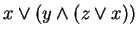 .
.
Problem
G-2.
For
 FDL
FDL , find the partially ordered set
 JI
JI and construct the lattice
Downsets
and construct the lattice
Downsets , which of course is
isomorphic to
, which of course is
isomorphic to  .
.
Problem
G-3. The  of a chain is the number of coverings
in it (one less than the number of elements). As you know, a
maximal chain in a partially ordered set is a chain that is
not contained in any other chain.
of a chain is the number of coverings
in it (one less than the number of elements). As you know, a
maximal chain in a partially ordered set is a chain that is
not contained in any other chain.
Show that if is a finite distributive lattice, then
all its maximal chains have the same length, namely,
the number of join-irreducibles in .
Problem
G-4. A group is generated by elements  if
all its elements are obtained by starting with and
then repeatedly taking products and inverses. Likewise, a lattice is
generated by elements if all its elements are obtainable from
by repeatedly taking meets and joins.
if
all its elements are obtained by starting with and
then repeatedly taking products and inverses. Likewise, a lattice is
generated by elements if all its elements are obtainable from
by repeatedly taking meets and joins.
(a)
FDL can be generated by three elements. Assuming this is
true, decide which three.
(b) Let  be the generators of
FDL. Write each
element of
FDL as an expression in the generators.
be the generators of
FDL. Write each
element of
FDL as an expression in the generators.
(c) Rewriting expressions from (b) where necessary, write each element
of
FDL as an expression in the generators in canonical form.
Problem G-5. You know that a finite distributive lattice can be represented by sets of its own join-irreducibles, so that it is embedded in a power-set lattice. What similar statement holds if meet-irreducibles are used instead?
Problem
G-6. For finite distributive lattices, you know various facts
involving meet-irreducibles, meet-prime elements, prime ideals,
join-irreducibles, join-prime elements, prime dual ideals, and
prime ideals versus their complements. Use this information to
show that in any finite distributive lattice , we have
MI JI, where
MI and
JI are
the partially ordered sets of meet-irreducibles and of join-irreducibles,
respectively.
JI, where
MI and
JI are
the partially ordered sets of meet-irreducibles and of join-irreducibles,
respectively.
Problem
G-7. For a distributive lattice with partially ordered set
 of join-irreducibles, sometimes we write
 .
.
(a) Why is this reasonable?
(b) The ordinary log function obeys
 .
Is there an analogous rule for finite distributive lattices?
.
Is there an analogous rule for finite distributive lattices?
(c) What about the rule
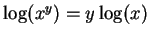 ?
?
Problem
G-8. A map
 of lattices is a homomorphism
if
of lattices is a homomorphism
if
 and
and
 .
.
(a) Let  be an element of a distributive lattice .
Show that the map
be an element of a distributive lattice .
Show that the map
 is a lattice homomorphism.
(b) Let ![$ [a,b] $](img76.gif) be an interval of a distributive lattice (so
be an interval of a distributive lattice (so  ). Show that the map
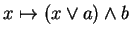 is a lattice homomorphism of onto .
(c) Describe the set of fixed points of this map.
Problem
G-9. Suppose that in a finite distributive , the
elements
 are distinct and cover
  .
Show that , the elements
.
Show that , the elements  , and the joins of
two or more of the form a sublattice of
isomorphic to
2
, and the joins of
two or more of the form a sublattice of
isomorphic to
2 .
.
Problem
G-10. Suppose that  is a finite
partially ordered set of width
is a finite
partially ordered set of width  . Show that
Downsets has a sublattice isomorphic to
2
. Show that
Downsets has a sublattice isomorphic to
2 .
(Notice that it doesn't work just to restrict downsets to an
antichain--that results in a lattice-homomorphic image rather
than a sublattice!)
.
(Notice that it doesn't work just to restrict downsets to an
antichain--that results in a lattice-homomorphic image rather
than a sublattice!)
Problem
G-11. The dimension of a partially ordered set  is the least integer
  such that is isomorphic to
a subset of a product of chains. Show that the dimension
of
2 is
such that is isomorphic to
a subset of a product of chains. Show that the dimension
of
2 is  . (Suggestion: Look at the atoms--the elements
that cover the bottom element--and the co-atoms--the elements that
are covered by the top element.)
. (Suggestion: Look at the atoms--the elements
that cover the bottom element--and the co-atoms--the elements that
are covered by the top element.)
Problem
G-12. The dimension of a partially ordered set is
defined in Problem G-![[*]](/lib/latex2html-icons/crossref.gif) . Show that the dimension of a
finite distributive lattice is equal to the width of
JI, the partially ordered set of join-irreducibles,
and that moreover can be lattice-embedded in the product
of that many chains, not just embedded as a partially ordered set.
(Intuitively, can be drawn as a lattice on -dimensional
graph paper if
JI has width .)
. Show that the dimension of a
finite distributive lattice is equal to the width of
JI, the partially ordered set of join-irreducibles,
and that moreover can be lattice-embedded in the product
of that many chains, not just embedded as a partially ordered set.
(Intuitively, can be drawn as a lattice on -dimensional
graph paper if
JI has width .)
Problem G-13. In trying to prove a statement about a finite distributive lattice, it is always wise to see whether the statement can be translated into a statement about the partially ordered set of join-irreducibles. Translate these statements:
(a) is the direct product of two chains. (Here ``is'' really
means ``is isomorphic to''.)
(b) is Boolean (i.e., every element  has a complementary
element
has a complementary
element  so that
 ,
,
 ).
).
In each case, your answer should be a statement that makes sense for an abstract partially ordered set.
Problem
G-14. Let be a finite partially ordered set of
width . Show that if  and
and  are downsets of
each with exactly maximal elements, then the same
is true of
are downsets of
each with exactly maximal elements, then the same
is true of  and
and  .
.
Problem
G-15. By Theorem , any
finite distributive lattice , is isomorphic to
Downsets JI
JI . Show that for any finite partially
ordered set , is isomorphic to
JIDownsets
. Show that for any finite partially
ordered set , is isomorphic to
JIDownsets . (These two statements together show a
correspondence between finite distributive lattices and finite
partially ordered sets.)
. (These two statements together show a
correspondence between finite distributive lattices and finite
partially ordered sets.)
Problem
G-16. Let be a finite partially ordered set of width
. Let be the set of all antichains of
that have elements. For  , write
 if each element of
  is
is  some element of
  . A theorem of Dilworth states that is a distributive
lattice. Prove this theorem. (Suggestion: Relate to
Problem G-.)
. A theorem of Dilworth states that is a distributive
lattice. Prove this theorem. (Suggestion: Relate to
Problem G-.)
Problem
G-17. Recall that Pascal's Triangle is the triangular table
whose entries are the binomial coefficients.
Typical rows of Pascal's Triangle are
 ,
and
,
and
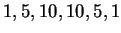 . The largest of the binomial coefficients
![$ \left[\begin{array}{c}n\\ k\end{array}\right]$](img102.gif) for given is the middle one ( odd) or the middle
two ( even).
for given is the middle one ( odd) or the middle
two ( even).
(a) Explain why in
2 there are
elements of ``rank''  for each .
(b) The width of
2 is clearly at least
![$ \left[\begin{array}{c}n\\ {[n/2]}\end{array}\right] $](img104.gif) .
For
2
.
For
2 show that this is exactly the width. (Method: Exhibit
that number of chains whose union is the whole partially ordered set.)
show that this is exactly the width. (Method: Exhibit
that number of chains whose union is the whole partially ordered set.)
Problem
G-18. For a partially ordered set , an automorphism of
is an isomorphism of onto itself. As usual, a subset  of
is invariant under an automorphism
of
is invariant under an automorphism  if
if
 .
.
(a) Show that a finite partially ordered set of width has an
antichain of elements that is invariant under all automorphisms.
(b) Prove Sperner's Theorem: For a finite set  , a maximum-sized
antichain in
Pow
, a maximum-sized
antichain in
Pow can be obtained from elements of fixed rank
(i.e., all subsets of some fixed cardinality, namely,
can be obtained from elements of fixed rank
(i.e., all subsets of some fixed cardinality, namely, ![$ [n/2] $](img109.gif) ).
).
(Suggestions: For (a): Consider the lattice of antichains
from
Problem G-. Could some one of its
elements be expected to be invariant? For (b) use (a). This nice
way of looking at Sperner's Theorem was discovered some time after
earlier lengthy proofs and more awkward generalizations.)
Problem
G-19. Show that every element of a finite
distribute lattice is uniquely an irredundant join of
join-irreducibles. (``Unique'' means up to rearrangement. An
expression
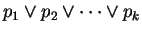 is redundant if some
  can be deleted without changing the
value. Method: As for unique factorization of integers. Note:
This problem concerns elements, but by using free distributive
lattices it can be seen that the same fact is true for expressions,
as in §.)
can be deleted without changing the
value. Method: As for unique factorization of integers. Note:
This problem concerns elements, but by using free distributive
lattices it can be seen that the same fact is true for expressions,
as in §.)