


Problem
B-1. (a) Draw a copy of
2 . (Think of it either as
2
. (Think of it either as
2 2
2 or as
2
or as
2 2
2 .)
.)
(b) Draw
Subgp Z
Z Z
Z , where
Z
, where
Z denotes the integers modulo 5.
Problem
B-2. Represent the partially ordered set of
Figure ![[*]](/lib/latex2html-icons/crossref.gif) as a union of chains, using as few as
possible:
as a union of chains, using as few as
possible:
Problem B-3. Give an example of a map between partially ordered sets that is isotone, one-to-one, and onto, but not an isomorphism.
Problem
B-4. A quasi-order on a set  is a relation
  that is reflexive and transitive but not necessarily antisymmetric.
Show that if is a quasi-ordered set, then the relation
that is reflexive and transitive but not necessarily antisymmetric.
Show that if is a quasi-ordered set, then the relation
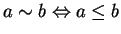 and
and  defines an equivalence relation
for which the set
defines an equivalence relation
for which the set  becomes a partially ordered set in a
natural way.
becomes a partially ordered set in a
natural way.
Problem
B-5. Show that every partially ordered set can be
represented by sets. In other words, show that for each
partially ordered set  there is a set
  such that
can be embedded in
Pow
such that
can be embedded in
Pow . (Suggestion: Take
  .
For partially ordered sets and , a map
.
For partially ordered sets and , a map
 is
an embedding if
is
an embedding if  is one-to-one and
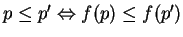 . In other words, is an isomorphism of with
a subset of .)
. In other words, is an isomorphism of with
a subset of .)
Problem
B-6. Show that
Div is isomorphic to a direct
product of chains.
is isomorphic to a direct
product of chains.
(For partially ordered sets and , the direct product
 consists of pairs as usual and is partially ordered
coordinatewise. Thus
consists of pairs as usual and is partially ordered
coordinatewise. Thus
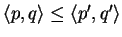

 and
and
 .)
.)
Problem
B-7. Let be a partially ordered set in which every
chain is finite and every antichain is finite. Show that
must be finite.
Problem
B-8. Suppose that  is a subgroup of a finite group
 . Show that there is a set of
 ![$ [G:H] $](img75.gif) elements of
that are simultaneously left coset representatives and right
coset representatives for .
elements of
that are simultaneously left coset representatives and right
coset representatives for .
Problem B-9. Show that every countable chain can be embedded in the chain Q of rationals.
(An embedding of a partially ordered set
into a partially ordered set is an isomorphism of with
a subset of . In general this is not the same thing as a
one-to-one isotone map of into , but when is a chain
it is the same thing.)
Problem B-10. A chain is said to be dense (or dense-in-itself) if no element covers another, and endless if it has no top element and no bottom element. Show that every two dense, endless, countably infinite chains are isomorphic. (Thus all are isomorphic to the chain Q of rationals.)
Problem
B-11. For partially ordered sets  , the ``cardinal power''
 is the set of all isotone functions from into ,
partially ordered pointwise. In other words, for
is the set of all isotone functions from into ,
partially ordered pointwise. In other words, for  isotone,
 means that
 for all
  .
.
(a) Draw a diagram of
3 (a chain to a chain power).
(b) For as an ``operation'' on partially ordered
sets, state analogues of these rules of algebra for positive real
numbers. For each analogue state whether it is true, up to
isomorphism. (You need not give proofs.)
(i)
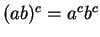 ,
,
(ii)
 ,
,
(iii)
 .
.
(The analogue of multiplication will be the direct product; the analogue of addition of two partially ordered sets will be to put them side by side, i.e., to form their disjoint union with no order relations between the two pieces.)
Problem
B-12. Sketch (a)
 and (b)
 (chains
to chain powers)
(chains
to chain powers)
Problem B-13. (This problem concerns chains to chain powers.)
(a) Describe
 more simply, up to isomorphism.
Use the rules for powers of partially ordered sets
(from a previous problem) to derive the strange result that
 .
.
Problem
B-14. Let
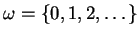 , as a chain. Prove:
For each
, as a chain. Prove:
For each  , every antichain in
 is finite.
(Here is not a chain, so
means
is finite.
(Here is not a chain, so
means
 .)
.)
Problem
B-15. A bipartite graph is a partially ordered set of
the kind used in Hall's matching theorem, where all elements are
maximal or minimal but not both. Can you find a bipartite graph
with five minimal elements such that for each  any
minimal elements are together related to at least maximal
elements, except for
any
minimal elements are together related to at least maximal
elements, except for  ?
?
Problem
B-16. Prove P. Hall's theorem on distinct representatives (Corollary
).
(Suggestion: Use the matching theorem. But what should be on the upper level and what on the lower?)
Problem
B-17. Prove the theorem on a system of common representatives
for two equipartitions (Corollary ).
(Suggestion: Use the matching theorem.)
Problem
B-18. Let
Q be the set of rational numbers.
(a) Show that
R can be embedded in
PowQ .
.
(b) Show that
Q has an uncountable family of
subsets whose pairwise intersections are finite.
Problem
B-19. If  is a well ordered set, a limit element in
is an element that does not cover any other element
and is not the least element of . Let
is a well ordered set, a limit element in
is an element that does not cover any other element
and is not the least element of . Let
 denote
the set of limit elements of . Let
denote
the set of limit elements of . Let
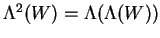 , etc. Construct explicitly a well ordered subset
of the reals such that
, etc. Construct explicitly a well ordered subset
of the reals such that
 is nonempty.