UCLA Geometry and Topology Workshop 2020
- Date: January 2-4, 2020
- Location: IPAM, UCLA
- Organisers: Ko Honda, Yi Ni, and Sucharit Sarkar
- Primarily funded by: NSF DMS-1643401
- With support from: UCLA Mathematics Department and IPAM
The workshop focused on recent developments in contact geometry and low-dimensional topology, with a particular emphasis on modern homological invariants. The workshop was open to all; the following photo captures most of the participants.
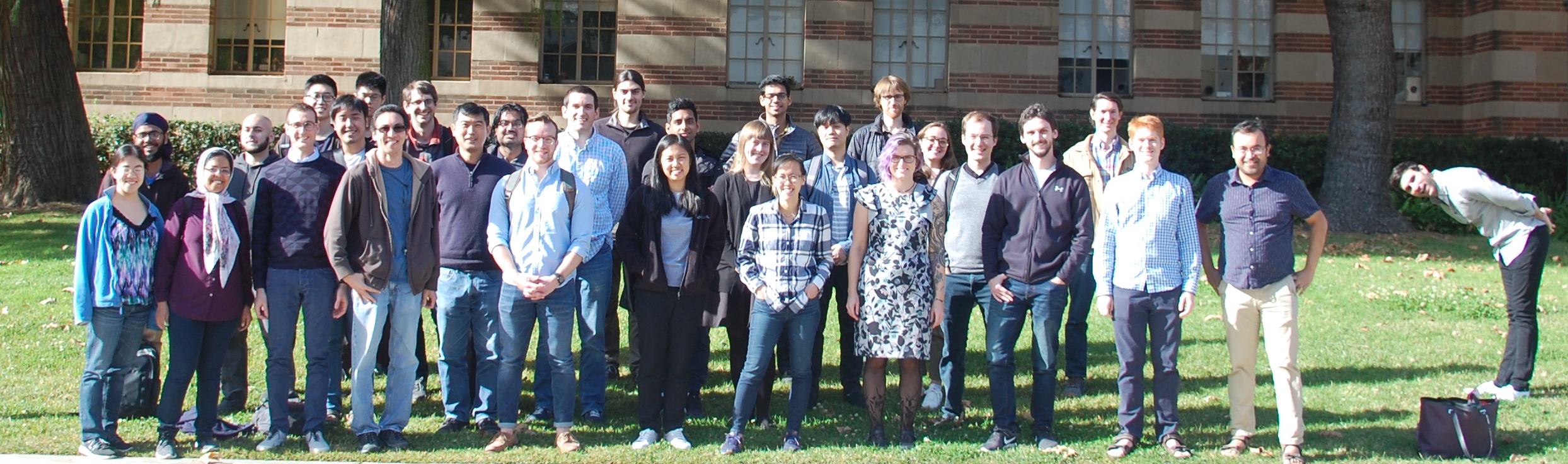
Speakers: Akram Alishahi, Irving Dai, Nathan Dowlin, Chris Gerig, Kyle Hayden, Kristen Hendricks, Jennifer Hom, Jianfeng Lin, Marco Marengon, Jo Nelson, Jacob Rooney, Xiaolin Danny Shi, Matthew Stoffregen, Linh Truong, Michael Willis, Ian Zemke.
Schedule
All talks were held at the Institute for Pure and Applied Mathematics (map of its location). Select a talk title to show or hide its abstract.
Thursday, January 2, 2020
- 08:30-09:30: Breakfast
- 09:30-11:00: Dai-Hom-Stoffregen-Truong
Homology cobordism and knot concordance
The set of homology 3-spheres, up to an equivalence relation called homology cobordism, forms an abelian group. We show that this group contains an infinite rank summand. The proof uses an algebraic modification of the involutive Heegaard Floer package of Hendricks-Manolescu and Hendricks-Manolescu-Zemke. We will also describe an infinite family of integer-valued concordance homomorphisms defined using knot Floer homology. These invariants have topological applications to concordance genus, concordance unknotting number, and bridge index.
- 11:00-13:00: Lunch break
- 13:00-14:00: Hayden
Knot trace invariants and exotic 4-manifolds
We show that the concordance invariant "nu" from knot Floer homology is a diffeomorphism invariant of the "trace" of a knot K, i.e. the 4-manifold obtained by attaching a 2-handle to the 4-ball along K. We'll use this computable invariant to distinguish exotic pairs of knot traces and other simple 4-manifolds. We'll also present examples which show that the related concordance invariants "tau" and "epsilon" are not knot trace invariants. This is joint work with Tom Mark and Lisa Piccirillo.
- 14:15-15:15: Zemke
Surgery exact triangles in involutive Heegaard Floer homology
We will describe work in progress to construct surgery exact triangles in Hendricks and Manolescu's involutive Heegaard Floer homology. This project is joint with K. Hendricks, J. Hom and M. Stoffregen. Our model uses a conceptually simple model for the involution. As an application, we obtain a "knot surgery formula", which allows the local equivalence class of the involutive Heegaard Floer homology of certain 3-manifolds to be computed.
- 15:30-16:30: Hendricks
Involutive bordered Floer homology
We give a bordered extension of the hat version of involutive Heegaard Floer homology and use it to give an algorithm to compute the invariant for general 3-manifolds. As an application, we prove that the hat version of involutive HF satisfies (various versions of) a surgery exact triangle. Most of this talk is joint with R. Lipshitz (and relies on technical results first recorded by R. Lipshitz, P. Ozsváth, and D. Thurston); a small portion at the end is joint with J. Hom, M. Stoffregen, and I. Zemke.
- 16:30-17:30: Tea
Friday, January 3, 2020
- 08:30-09:30: Breakfast
- 09:30-11:00: Alishahi-Dowlin
Holomorphic motivations for an algebraically defined knot Floer type invariant (Dowlin)
I will define a link invariant which is isomorphic to (delta-graded) knot Floer homology. Like knot Floer homology, is defined as a Lagrangian Floer homology, so the differential is a count of pseudo-holomorphic curves. By making certain simplifications in the chain complex, I will provide a guess for the homology which has a combinatorial description. The result is an algebraically defined link invariant which is conjecturally isomorphic to . The algebraically defined complex also comes equipped with a cube filtration; it turns out that the page of the spectral sequence induced by this filtration is Khovanov homology.
An algebraic braid invariant vs holomorphic invariants (Alishahi)
I will continue with describing a local approach to prove our conjecture. First, I will sketch a tangle refinement of our algebraically defined , and then I will compare it with the Ozsváth-Szabó's tangle invariants. Specifically, our local invariants have the structure of a DA bimodule, defined over an algebra isomorphic to the Ozsváth-Szabó's algebra, and our DA bimodule for any open braid is chain homotopic to their braid invariant.
- 11:00-13:00: Lunch break
- 13:00-14:00: Nelson
-equivariant and nonequivariant contact homology
I will discuss joint work with Hutchings which constructs nonequivariant and a family Floer equivariant version of contact homology. Both theories are generated by two copies of each Reeb orbit over and capture interesting torsion information. I will then explain how one can recover the original cylindrical theory proposed by Eliashberg-Givental-Hofer via our construction.
- 14:15-15:15: Gerig
Probing smooth 4-manifolds with near-symplectic forms
Most 4-manifolds do not admit symplectic forms, but most admit near-symplectic forms, certain closed 2-forms which are symplectic outside of a collection of circles. Just like the Seiberg-Witten (SW) invariants, there are invariants in terms of J-holomorphic curves that are compatible with the near-symplectic form. Although the SW invariants don't apply to (potentially exotic) 4-spheres, nor do these spheres admit near-symplectic forms, there is still a way to bring in near-symplectic techniques and various contact Floer homologies.
- 15:30-16:30: Rooney
Cobordism maps in embedded contact homology
An outstanding problem in embedded contact homology has been a self-contained construction of cobordism maps via a count of holomorphic curves. We give such a construction for contact manifolds with no elliptic Reeb orbits up to a certain action. The maps are defined by counting both curves in the cobordism and new objects that we call ECH buildings.
- 16:30-17:30: Tea
Saturday, January 4, 2020
- 08:30-09:30: Breakfast
- 09:30-11:00: Lin-Shi
The geography problem of 4-manifolds: 10/8+4
A fundamental problem in 4-dimensional topology is the following geography question: "which simply connected topological 4-manifolds admit a smooth structure?" After the celebrated work of Kirby-Siebenmann, Freedman, and Donaldson, the last uncharted territory of this geography question is the "11/8-Conjecture". This conjecture, proposed by Matsumoto, states that for any smooth spin 4-manifold, the ratio of its second Betti number and signature is at least 11/8. Furuta proved the "10/8+2"-Theorem by studying the existence of certain Pin(2)-equivariant stable maps between representation spheres. In this talk, we will present a complete solution to Furuta's problem by analyzing the Pin(2)-equivariant Mahowald invariants. In particular, we improve Furuta's result into a "10/8+4"-Theorem. Furthermore, we show that within the current existing framework, this is the limit. This talk is based on joint work by Mike Hopkins, Jianfeng Lin, XiaoLin Danny Shi and Zhouli Xu.
- 11:15-12:45: Marengon-Willis
A generalization of Rasmussen's invariant, with applications to surfaces in some four-manifolds
Building on previous work of Rozansky and Willis, we generalise Rasmussen's s-invariant to connected sums of . Such an invariant can be computed by approximating the Khovanov-Lee complex of a link in with that of appropriate links in . We use the approximation result to compute the s-invariant of a family of links in which seems otherwise inaccessible, and use this computation to deduce an adjunction inequality for null-homologous surfaces in a (punctured) connected sum of . This inequality has several consequences: first, the s-invariant of a knot in the three-sphere does not increase under the operation of adding a null-homologous full twist. Second, the s-invariant cannot be used to distinguish from homotopy 4-spheres obtained by Gluck twist on . We also prove a connected sum formula for the s-invariant, improving a previous result of Beliakova and Wehrli. We define two s-invariants for links in . One of them gives a lower bound to the slice genus in and the other one to the slice genus in . Lastly, we give a combinatorial proof of the slice Bennequin inequality in . This is joint work of the speakers with Ciprian Manolescu and Sucharit Sarkar.