


Definition. In a lattice  with 0 and 1,
  is a complement of
 if
if
 ,
,
 .
.
Proposition. In a distributive lattice, complements are unique.
Definition. A Boolean lattice is a distributive lattice
with 0 and 1 in which every element has a complement and  .
.
The complement of is denoted  .
.
Definition. A Boolean algebra is a Boolean lattice in which
complementation is regarded as an operation. It is best to
regard 0 and 1 as constant operations. Thus the algebra has the
form
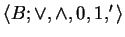 .
.
Thinking of complementation as an operation makes a difference when subalgebras or homomorphisms are considered. Thus a Boolean subalgebra is a sublattice that is also closed under complementation and contains 0 and 1. (In particular, a Boolean subalgebra cannot be empty, unlike a sublattice.)
 In a Boolean lattice
  , the complementation
map
, the complementation
map
 is a ``dual isomorphism'', meaning an
isomorphism of with its dual (i.e., upside-down).
In other words, the complementation map is one-to-one and obeys
de Morgan's laws
is a ``dual isomorphism'', meaning an
isomorphism of with its dual (i.e., upside-down).
In other words, the complementation map is one-to-one and obeys
de Morgan's laws
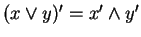 and
and
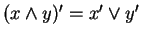 .
.