


In addition to Mal'tsev's theorem, the following facts hold, among others.
Some of them refer to a majority term, which means
a ternary term  obeying the three laws
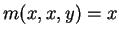 ,
,
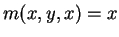 ,
,
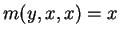
in the variety in question.
2.1 Theorem (Pixley) For a variety  , the following are equivalent:
(a) is arithmetic;
(b) there are terms  and such that in ,
  obeys Mal'tsev's laws of (b) in Theorem
 ![[*]](/lib/latex2html-icons/crossref.gif) .
and
.
and  is a majority term;
(c) there is a term  such that in ,
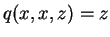 (minority of entries),
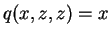 (minority of entries),
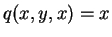 (majority of entries).
2.2 Theorem (Jónsson) For a variety , the following are equivalent:
(a) is congruence-distributive;
(b) for some  , there are terms
 in
in  such that in ,
(i)
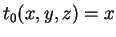 ,
,
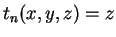 ;
;
(ii)
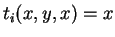 , for all
  ;
;
(iii)
 for even,
 for odd.
(Notice that the case  is equivalent to the existence of a majority term.)
2.3 Theorem (Day, Gumm) For a variety , the following are equivalent:
(a) is congruence-modular;
(b) for some  , there are terms
and
in such that in ,
, there are terms
and
in such that in ,
(i)
(ii)
, for all ;
(iii)
for even,
for odd.
(iv)
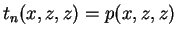 ,
,
(v)
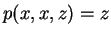 .
.