


Proposition. For every variety  and every
  there exists
a free algebra in with generators. In other words,
there exists
a free algebra in with generators. In other words,
 always exists.
Outline of proof #1: The method of saving term relations in common.
This is a generalization of the ``table'' method (above) for a single
algebra: We start by considering all functions
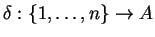 where
where  runs through all algebras in .
Since is too large to be a set, there are also too many
runs through all algebras in .
Since is too large to be a set, there are also too many
 's, so we restrict our attention to cases where the
image of generates , and we remark that up to
isomorphism there is only a set (rather than a class) of ways in
which an image of such a can sit inside the it
generates. Let
's, so we restrict our attention to cases where the
image of generates , and we remark that up to
isomorphism there is only a set (rather than a class) of ways in
which an image of such a can sit inside the it
generates. Let  consist of one from each
isomorphism class. Then inside
consist of one from each
isomorphism class. Then inside
 , for
, for
 let
let  be the element whose -th coordinate
is
be the element whose -th coordinate
is  , and let
  be the subalgebra of
generated by
be the subalgebra of
generated by
 . Then we remark
that has the Universal Mapping Property (UMP), so is free.
I call this the method of ``saving relations in common'', because
the only relations
. Then we remark
that has the Universal Mapping Property (UMP), so is free.
I call this the method of ``saving relations in common'', because
the only relations  between the are those true
in every factor, and the factors account for all ways that
elements of an algebra in can be related. As you see,
there are two elements in this proof: choosing the isomorphism
types and taking the subalgebra of a product.
between the are those true
in every factor, and the factors account for all ways that
elements of an algebra in can be related. As you see,
there are two elements in this proof: choosing the isomorphism
types and taking the subalgebra of a product.
Outline of proof #2: The method of overshooting.
For
 (the algebra of all terms in
variables), let
(the algebra of all terms in
variables), let
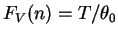 , where
 Con
Con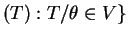 . Here
 is the least congruence relation
  on
on
 such that
 . One can show that inherits the UMP from
  , which is free in the variety
of all algebras of type
, which is free in the variety
of all algebras of type  . I call this the ``overshooting''
method: Since is free but much too big, you have overshot,
and you must trim down to where it fits in , by taking
modulo a congruence relation.
. I call this the ``overshooting''
method: Since is free but much too big, you have overshot,
and you must trim down to where it fits in , by taking
modulo a congruence relation.