


Suppose
 Con
Con . Let
. Let
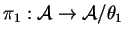 and
and
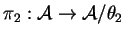 be the natural homomorphisms. Combining these,
we get a a homomorphism
be the natural homomorphisms. Combining these,
we get a a homomorphism
 (not necessarily onto).
What is its kernel? By considering when
(not necessarily onto).
What is its kernel? By considering when
 have
equal images, we see that the kernel is
have
equal images, we see that the kernel is
 . From this and the first isomorphism theorem we get
this fact:
. From this and the first isomorphism theorem we get
this fact:
6.1 Theorem (subdirect embedding theorem).
For an algebra  and
Con, there is a natural embedding of
and
Con, there is a natural embedding of
 .
.
(``Subdirect'' means that the image of the embedding inside the product is large enough to map onto each factor. This will be important later.)
6.2 Corollary. If has congruence relations
 with
with
 (the equality
relation), then
(the equality
relation), then
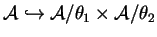 (an embedding).