


Problem
J-1. Let  be the lattice of all finite subsets of
an infinite set
be the lattice of all finite subsets of
an infinite set  . Characterize
Ideals
. Characterize
Ideals up to
isomorphism, preferably as a more familiar lattice.
up to
isomorphism, preferably as a more familiar lattice.
Problem
J-2. Prove Fact (e) in §![[*]](/lib/latex2html-icons/crossref.gif) . If the lattice is
distributive, relate this to meet-irreducibility.
. If the lattice is
distributive, relate this to meet-irreducibility.
Problem
J-3. Show that the following conditions are equivalent for
an ideal  in a lattice :
is a prime ideal;
 is a dual ideal;
is a prime dual ideal; i.e., if
 ,
,  is a dual ideal such that
 implies
  or
or  .
.
Problem
J-4. (a) Explain how homomorphisms of a lattice
onto
2 correspond to prime ideals of .
(b) For
 2
2 3, there are several homomorphisms of
onto
2. For each, indicate its kernel by darkening
coverings on a copy of .
3, there are several homomorphisms of
onto
2. For each, indicate its kernel by darkening
coverings on a copy of .
Problem
J-5. Let be a countably infinite set. In the Boolean algebra
Pow of all finite and cofinite subsets of
, find a prime ideal that is not principal.
of all finite and cofinite subsets of
, find a prime ideal that is not principal.
Problem
J-6. Let  be the ring of all continuous functions
![$ f : [0,1] \rightarrow$](img68.gif) R, where
R is the field of reals
and
R, where
R is the field of reals
and
![$ [0,1] \subseteq$](img69.gif) R. For
R. For
![$ x \in [0,1]$](img70.gif) , let
, let
 .
.
(a) Show that  is a maximal ideal, for each
  .
.
(b) Show that every maximal ideal of is of the form
.
(c) The support of a function  is
is
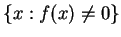 ,
the set of points where the function does not vanish. Show
that the supports of continuous functions on
,
the set of points where the function does not vanish. Show
that the supports of continuous functions on ![$ [0,1]$](img75.gif) form
a base for the topology of . In other words, every
open subset of is a union of supports.
form
a base for the topology of . In other words, every
open subset of is a union of supports.
For a commutative ring  with 1, let
  be its
set of maximal ideals. The support of an element
be its
set of maximal ideals. The support of an element  is
is
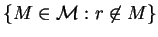 . The maximal ideal space of
is topologized by using the supports of elements
as a base.
. The maximal ideal space of
is topologized by using the supports of elements
as a base.
(d) Show that the maximal ideal space of is homeomorphic
to . Thus can be reconstructed from ,
up to homeomorphism.
(e) Outline how it could be proved that is not isomorphic
to the ring  of real-valued continuous functions on the unit circle.
(It is not necessary to prove the steps.)
of real-valued continuous functions on the unit circle.
(It is not necessary to prove the steps.)
Problem
J-7. Let be a lattice and let
 be a family of ideals of , possibly infinitely many. Describe
(with proof) the elements of the ideal generated by all
be a family of ideals of , possibly infinitely many. Describe
(with proof) the elements of the ideal generated by all
 , i.e.,
the smallest ideal containing all the ideals
. Your
description should generalize §(c).
, i.e.,
the smallest ideal containing all the ideals
. Your
description should generalize §(c).