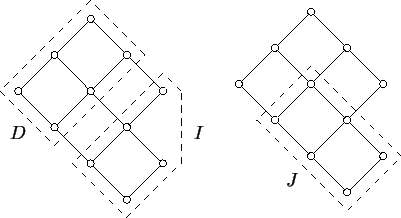
The concepts are the same, with  for
for  and
and
 for
for  , but it's easier to use these
equivalent definitions:
, but it's easier to use these
equivalent definitions:
(1) An ideal of  is a nonempty downset closed under joins.
(2) An ideal  is principal if
 ![$ I = ( a ]$](img20.gif) ,
i.e.,
,
i.e.,
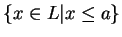 , for some
  .
.
(3) An ideal is proper if  .
.
(4) An ideal is prime if is proper and
 implies
  or
or  .
.
(5) An ideal of is maximal if is proper
and there is no ideal  with
with  .
.