


2.1 Theorem. Let  be a finite
distributive lattice, and let
be a finite
distributive lattice, and let
 JI
JI , the set of
join-irreducibles of with the partial order inherited
from . Then
, the set of
join-irreducibles of with the partial order inherited
from . Then
 Downsets
 .
.
Corollary. Every finite distributive lattice is isomorphic to a sublattice
of some power set, namely
Pow where
where  is the set of its
join-irreducibles.
is the set of its
join-irreducibles.
(Actually, every infinite distributive lattice is likewise isomorphic to a lattice of sets, but in a more subtle way. This is the Stone Representation Theorem.)
Remark. In a finite distributive lattice, every element is
uniquely an irredundant join of join-irreducibles. (Contrast this
with the case of  .)
.)
An example of a lattice of downsets is shown in Figure ![[*]](/lib/latex2html-icons/crossref.gif) .
.
2.2 Corollary. Let be a finite distributive
lattice, and let
 JI
JI , the dual of
JI.
Then
2
, the dual of
JI.
Then
2 , the lattice of isotone functions from
 to
2.
to
2.
Proof. Observe that for a partially ordered set ,
2 Downsets
 . In fact, each isotone function
 2 gives
a decomposition of into
2 gives
a decomposition of into
 , which is a downset, and
 , which is the complementary upset, and in the other
direction each downset gives a complementary upset and isotone function.
This correspondence reverses order since
, which is the complementary upset, and in the other
direction each downset gives a complementary upset and isotone function.
This correspondence reverses order since  when
when  ``has
more 1's'' than
``has
more 1's'' than  , or equivalently ``fewer 0's'', so that
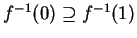 .
.
Note. As we shall see later, infinite distributive lattices can also be represented as lattices of subsets.