


Theorem. If  is well partially ordered, then so is
  ,
the set of finite words (finite sequences) from , where
,
the set of finite words (finite sequences) from , where
 means that
 ,
,
 , ...,
 for some
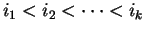 .
.
Note that Example (c) above is the case where is totally unordered.
Some useful notation: Let us write
 for elements of
and
for elements of
and
 for elements of .
The empty sequence is allowed. Let
for elements of .
The empty sequence is allowed. Let
 mean
mean
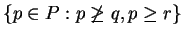 , let
, let
 mean
mean
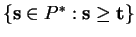 , etc. Observe that
 is an upset of
and
is an upset of
and
 is a downset. Also observe that for
  ,
,
 is the same thing as
 (where
  is regarded as a one-letter word).
Proof of the Theorem.
Suppose is not wpo. Let  be a downset of
minimal with respect to the property that
be a downset of
minimal with respect to the property that  is not
wpo; by Observation 5, such a exists. Without loss of
generality, is . Then for all ,
, or equivalently
,
is wpo. In contrast,
is not
wpo; by Observation 5, such a exists. Without loss of
generality, is . Then for all ,
, or equivalently
,
is wpo. In contrast,
 is
not wpo for some string
is
not wpo for some string
 in place of ; indeed, let
  be any
element of an infinite antichain or strictly decreasing sequence
in .
be any
element of an infinite antichain or strictly decreasing sequence
in .
Re-choose if necessary to have the least possible
length. Write
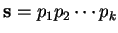 . Clearly
is not empty, so
. Clearly
is not empty, so  . Let
. Let  be the shorter string
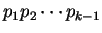 (empty if
  ). Then
 is wpo.
Now examine
 . Let
. Let
 be one of its elements. Since
 , we
can write
, we
can write
 , where
 . In fact, by choosing
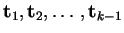 as short as possible in
turn (so that
as short as possible in
turn (so that  stops just before the first element
that is
stops just before the first element
that is  , etc.), we have
 , for all
 . Since
 , we have
 as well. In other words,
is an isotone image of part of
as well. In other words,
is an isotone image of part of
 , so is wpo. But then
, which is the union of the wpo sets
and
, is also wpo, a contradiction.
, so is wpo. But then
, which is the union of the wpo sets
and
, is also wpo, a contradiction.